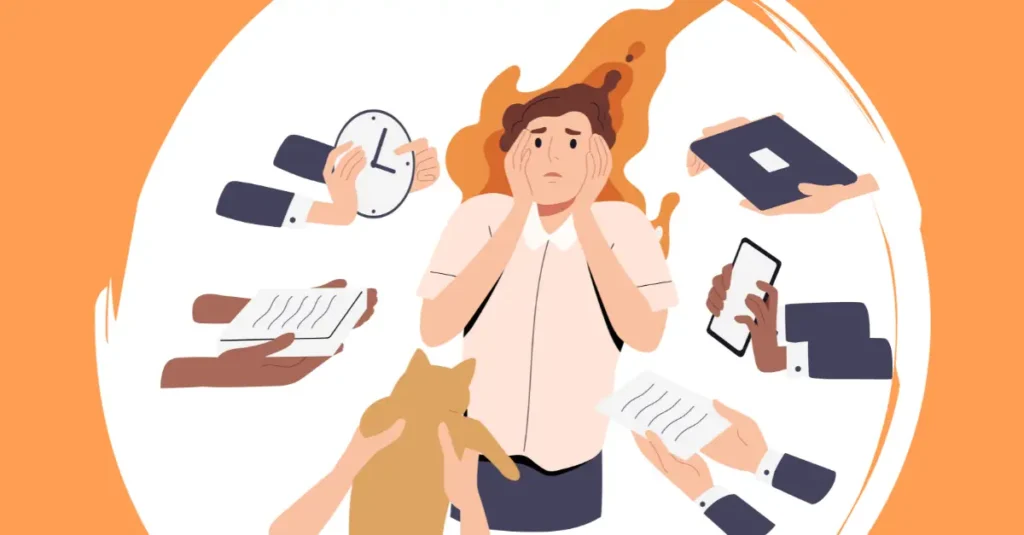
If you’ve ever checked whether you locked the door…
And then checked again…
And then taken a photo of the locked door so you could verify it later…
And then still worried about it while eating lunch…
Congratulations.
Your anxiety has successfully hired a bodyguard.
Unfortunately, the bodyguard is making the situation worse.
One of the strangest things about anxiety is that many of the things we do to feel safer can accidentally keep anxiety alive.
Psychologists call these habits safety behaviors.
And if you’re wondering what are safety behaviors in anxiety, you’re not alone.
The answer explains why anxiety can stick around even when we’re trying very hard to get rid of it.
Because anxiety is sneaky.
It doesn’t always survive because danger is present.
Sometimes it survives because your brain never gets the chance to discover that danger wasn’t there in the first place.
Let’s talk about it.

What Are Safety Behaviors in Anxiety?
Before exploring examples, we need to answer the question:
What are safety behaviors in anxiety?
Safety behaviors are actions people use to prevent feared outcomes or reduce anxiety.
They usually provide temporary relief.
That’s why they feel helpful.
The problem is that they often prevent people from learning that the feared situation was manageable all along.
Cognitive Behavioral Therapy (CBT) identifies safety behaviors as one of the major processes that maintain anxiety disorders.
In simple terms:
Anxiety says:
“Something bad might happen.”
You perform a safety behavior.
Nothing bad happens.
Your brain concludes:
“Good thing I did the safety behavior.”
Instead of:
“Oh. Maybe nothing bad was going to happen anyway.”
That distinction matters enormously.
1. Constant Reassurance Seeking
One of the most common answers to what are safety behaviors in anxiety is reassurance seeking.
“Are you sure?”
“Do you think everything is okay?”
“Do you think they are mad at me?”
“Do you think I made the right decision?”
At first, reassurance feels wonderful.
For approximately six minutes.
Then anxiety returns.
Which creates the need for more reassurance.
The relief is real.
But it’s temporary.
Over time, the brain becomes dependent on external confirmation instead of building internal confidence.
2. Excessive Checking
Checking behaviors are another classic example of what are safety behaviors in anxiety.
Checking locks.
Checking emails.
Checking assignments.
Checking symptoms.
Checking whether you offended someone.
Checking whether you remembered something correctly.
The irony is that checking often increases doubt.
Because the brain starts asking:
“If I needed to check, maybe there really was a problem.”
And suddenly certainty becomes harder to achieve.
Not easier.
3. Avoiding Situations That Create Anxiety
Avoidance feels logical.
If something makes you anxious, stay away from it.
Problem solved.
Except it usually isn’t.
One of the most important concepts when discussing what are safety behaviors in anxiety is avoidance.
The brain learns from experience.
When you repeatedly avoid a situation, your brain never receives evidence that you could have handled it.
The feared situation remains mysterious.
And mysterious things tend to remain scary.
4. Carrying “Just in Case” Items Everywhere
Many anxious people carry objects that help them feel safer.
Water bottles.
Medication.
Chargers.
Emergency contacts.
Comfort objects.
Backup plans for backup plans.
And occasionally backup plans for those backup plans.
Not all preparation is unhealthy.
The key question is whether the item is genuinely useful or functioning as a psychological crutch.
This distinction becomes important when understanding what are safety behaviors in anxiety.
5. Mentally Rehearsing Every Possible Disaster
Anxiety often disguises itself as preparation.
People convince themselves they’re problem-solving.
In reality, they’re repeatedly simulating catastrophes.
“What if I forget what to say?”
“What if I embarrass myself?”
“What if I fail?”
“What if something goes wrong?”
One reason discussions about what are safety behaviors in anxiety matter is that some safety behaviors happen entirely inside the mind.
No visible behavior is required.
The safety strategy becomes endless mental preparation.
6. Bringing Other People Into Your Anxiety
Anxiety loves assistants.
Friends become assistants.
Partners become assistants.
Family members become assistants.
People are recruited to provide reassurance, checking, monitoring, validation, and emotional certainty.
Again, support itself is not unhealthy.
The issue is dependence.
When understanding what are safety behaviors in anxiety, psychologists look at whether the behavior helps build confidence or merely reduces discomfort temporarily.
Those are very different outcomes.
7. Escaping Discomfort Too Quickly
Perhaps the most overlooked answer to what are safety behaviors in anxiety is immediate escape.
You leave the room.
End the conversation.
Cancel the plan.
Close the email.
Avoid the challenge.
The moment anxiety appears, you leave.
The short-term result feels fantastic.
The long-term result is less helpful.
Your brain learns:
“I escaped and survived.”
Instead of:
“I stayed and survived.”
And those lessons create very different futures.
Why Safety Behaviors Keep Anxiety Alive
Now that we’ve answered what are safety behaviors in anxiety, we can examine why they become problematic.
The issue isn’t that they reduce anxiety.
They do.
The issue is that they reduce anxiety too effectively.
They prevent learning.
The brain never receives new information.
It never discovers:
- The conversation was manageable.
- The mistake wasn’t catastrophic.
- The uncertainty was tolerable.
- The feared outcome never happened.
Without these experiences, anxiety remains unconvinced.
The alarm system stays active.
What CBT Teaches Instead
One of the central goals of Cognitive Behavioral Therapy is helping people gradually reduce safety behaviors.
Not recklessly.
Not all at once.
Gradually.
Because confidence is built through experience.
Not reassurance.
Not avoidance.
Not checking.
Experience.
The brain needs opportunities to discover:
“I can handle this.”
And often that discovery happens only when the safety behavior is no longer doing all the work.
Final Thoughts
Perhaps the strangest thing about what are safety behaviors in anxiety is that they usually come from a good place.
People are trying to feel safe.
Trying to feel prepared.
Trying to reduce suffering.
The intention isn’t the problem.
The unintended consequences are.
Anxiety often acts like an overprotective parent.
It wants guarantees.
Certainty.
Proof.
Backup plans.
More backup plans.
And occasionally a backup plan for the backup plan.
Life, unfortunately, refuses to provide most of those things.
Which means learning to tolerate uncertainty becomes one of the most powerful psychological skills a person can develop.
The next time anxiety tells you to check one more time, seek one more reassurance, or avoid one more uncomfortable situation, pause.
Ask yourself:
“Is this actually protecting me?”
Or is it simply making my anxiety feel temporarily comfortable?
Because sometimes the thing keeping anxiety alive isn’t the fear itself.
It’s the bodyguard you’ve been paying to protect it.
Subscribe to PsychUniverse
Get the latest updates and insights.
Join 3,084 other subscribers!
Niwlikar, B. A. (2026, June 12). What Are Safety Behaviors in Anxiety? 7 Sneaky Habits That Keep Anxiety Alive. PsychUniverse. https://psychuniverse.com/what-are-safety-behaviors-in-anxiety/