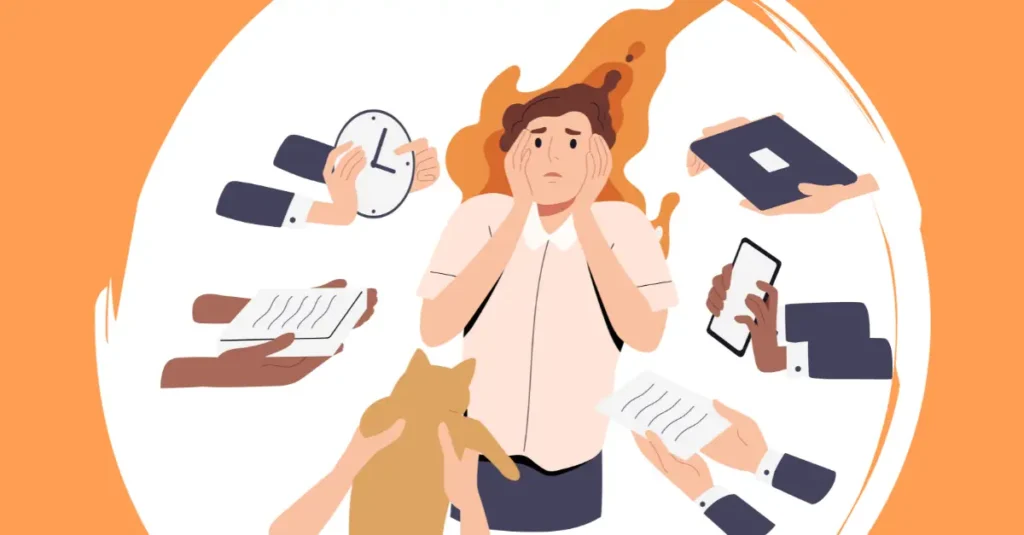
Let’s start with a completely scientific experiment.
You opened the fridge.
Forgot why.
Closed it.
Walked away.
Remembered why.
Went back.
Opened Instagram on the way.
Twenty-five minutes later, you somehow know what your classmate from eighth grade had for breakfast.
Naturally, your next thought is:
“Wait… do I have ADHD?”
Or maybe you lost your keys.
Again.
Forgot your water bottle.
Again.
Started three tasks.
Finished none.
Again.
Welcome to the internet, where every forgotten password, missed deadline, and attention span shorter than a YouTube ad has one explanation:
“You definitely have ADHD.”
Except…
That’s not how psychology works.
And that’s definitely not what is ADHD.
The truth is, everyone gets distracted.
Everyone procrastinates sometimes.
Everyone loses focus during a boring lecture, an endless meeting, or the fifteenth PowerPoint slide titled “Objectives.”
That doesn’t automatically mean you have Attention-Deficit/Hyperactivity Disorder.
Because what is ADHD is far more complex and far more misunderstood than social media often makes it seem.
So before diagnosing yourself because you forgot your charger for the third time this week, let’s answer the question properly.

What Is ADHD?
The simplest answer to what is ADHD is this:
Attention-Deficit/Hyperactivity Disorder (ADHD) is a neurodevelopmental disorder that affects the way the brain regulates attention, impulse control, activity levels, and executive functioning.
Notice something interesting?
It doesn’t simply say:
“People with ADHD can’t pay attention.”
Because that’s one of the biggest myths.
In reality, people with ADHD can pay attention.
Sometimes they pay attention so intensely that they lose track of time completely.
This is often called hyperfocus.
The challenge isn’t an inability to pay attention.
It’s difficulty regulating attention.
Think of attention like a spotlight.
For most people, the spotlight is reasonably easy to move.
For someone with ADHD, that spotlight often has a mind of its own.
Sometimes it refuses to shine where it’s needed.
Other times it refuses to switch off.
That’s a much better way to understand what is ADHD.
Everyone Gets Distracted. ADHD Is Different.
Let’s be honest.
Modern life is practically designed to distract us.
Your phone buzzes.
Your smartwatch vibrates.
Someone sends a meme.
Three notifications appear.
You open Instagram “for two minutes.”
Forty-five minutes disappear.
That’s not necessarily ADHD.
That’s also technology doing what it was designed to do.
This is why understanding what is ADHD means looking beyond isolated behaviours.
Psychologists don’t diagnose ADHD because someone occasionally procrastinates or forgets appointments.
Instead, they look for persistent patterns that have been present since childhood and that significantly interfere with daily functioning.
That’s a very different conversation.
ADHD Is About Executive Functioning
Here’s a phrase you’ll hear psychologists use a lot:
Executive functioning.
Think of executive functions as the brain’s management team.
They’re responsible for things like:
- Planning.
- Organising.
- Prioritising.
- Managing time.
- Starting tasks.
- Finishing tasks.
- Controlling impulses.
- Holding information in working memory.
- Switching attention when needed.
When these processes don’t work efficiently, everyday life can become surprisingly difficult.
Not because someone is lazy.
Not because they don’t care.
But because the brain’s “management system” is working differently.
That’s one of the most important things to understand about what is ADHD.
It’s not a lack of intelligence.
It’s not a lack of motivation.
It’s a difference in how the brain manages and regulates behaviour.
The Three Presentations of ADHD
Many people imagine ADHD as one hyperactive child who can’t sit still in class.
Reality is much broader.
Psychologists generally describe ADHD in three presentations.
1. Predominantly Inattentive Presentation
This is often what people picture when they hear someone say,
“I can’t focus.”
Common signs include:
- Frequently losing things.
- Forgetting appointments.
- Making careless mistakes.
- Becoming easily distracted.
- Difficulty finishing tasks.
- Appearing not to listen even when trying.
Interestingly, this presentation is sometimes overlooked because it’s quieter.
Someone may not be disruptive at all.
They’re simply struggling internally.
2. Predominantly Hyperactive-Impulsive Presentation
This presentation involves behaviours such as:
- Constant fidgeting.
- Feeling restless.
- Talking excessively.
- Interrupting conversations.
- Acting before thinking.
- Difficulty waiting for one’s turn.
Hyperactivity isn’t always running around the room.
In adults, it may simply feel like an engine that never quite switches off.
Restlessness can happen inside the mind as much as in the body.
3. Combined Presentation
Many people experience a combination of both inattentive and hyperactive-impulsive symptoms.
Which is another reminder that what is ADHD doesn’t look exactly the same for everyone.
Some people struggle mostly with organisation.
Others with impulsivity.
Others with both.
That’s why two people with ADHD can have very different experiences while sharing the same diagnosis.
So… When Does It Become ADHD?
This is where things get interesting.
Because everyone gets distracted.
Everyone procrastinates.
Everyone has walked into a room and completely forgotten why.
Everyone has stared at their laptop while their brain quietly whispers,
“Let’s reorganize the spice rack instead.”
The difference isn’t that people with ADHD experience these things.
The difference is how often, how intensely, and how much those difficulties interfere with everyday life.
Understanding what is ADHD means understanding that psychologists don’t diagnose isolated moments.
They diagnose patterns.
For an ADHD diagnosis, symptoms usually:
- Begin in childhood.
- Occur across multiple settings (for example, both at school and at home, or at work and in personal life).
- Persist over time rather than appearing during a stressful week.
- Cause significant impairment in academic, occupational, or social functioning.
Imagine missing deadlines not because you don’t care—but because starting the task feels like trying to push a car uphill.
Imagine wanting to listen during a conversation but realizing halfway through that your thoughts have already taken a completely different route.
Imagine trying every planner, every productivity app, every motivational quote on Pinterest…
…and still struggling.
That’s no longer simple distraction.
That’s when psychologists begin asking whether ADHD might be involved.
“But I Can Focus for Hours on Things I Like!”
Exactly.
And that’s one of the biggest misconceptions about ADHD.
Many people ask,
“How can someone with ADHD binge-watch an entire TV series or spend six hours playing video games if they ‘can’t pay attention’?”
Because what is ADHD isn’t an attention deficit in the literal sense.
It’s a difficulty regulating attention.
People with ADHD often find it hard to direct attention toward tasks that feel repetitive, boring, or have delayed rewards.
At the same time, they may become deeply absorbed in activities that are stimulating, novel, or personally meaningful.
This intense concentration is known as hyperfocus.
Ironically, someone who struggles to answer one email may spend four uninterrupted hours designing a digital illustration or researching an obscure historical event.
The issue isn’t that attention is absent.
It’s that the brain’s “attention switch” doesn’t always cooperate.
The Biggest Myths About ADHD
Let’s clear a few things up.
Myth 1: “Everyone has ADHD these days.”
No.
Everyone experiences distraction.
ADHD is a neurodevelopmental disorder.
Those are not the same thing.
Myth 2: “People with ADHD are just lazy.”
Perhaps one of the most damaging myths.
People with ADHD often put in enormous effort simply to complete tasks that others take for granted.
Imagine trying to run a race while someone keeps moving the finish line.
That’s how executive dysfunction can feel.
The problem isn’t effort.
It’s regulation.
Myth 3: “Only children have ADHD.”
Not true.
Many adults receive an ADHD diagnosis later in life.
Sometimes they’ve spent years believing they were simply “careless,” “lazy,” or “bad at managing time.”
Understanding what is ADHD also means recognizing that it doesn’t magically disappear at eighteen.
It simply changes how it shows up.
Myth 4: “If you get good grades, you can’t have ADHD.”
Also false.
Some people develop remarkable coping strategies.
Others rely on intelligence, family support, or structured environments.
Success doesn’t automatically rule out ADHD.
Struggle isn’t always visible.
How Is ADHD Treated?
Here’s the encouraging news.
ADHD is manageable.
Many people with ADHD live fulfilling, successful, and deeply meaningful lives.
Treatment usually depends on the individual’s age, symptoms, and needs.
It may include:
- Psychoeducation, helping people understand how ADHD affects their brain.
- Cognitive Behavioural Therapy (CBT), particularly for managing organisation, procrastination, emotional regulation, and unhelpful thinking patterns.
- Behavioural strategies that build routines and reduce everyday difficulties.
- ADHD coaching, which focuses on practical skills such as planning, prioritising, and time management.
- Medication, when recommended by a qualified psychiatrist, which can significantly improve attention and impulse regulation for many individuals.
Treatment isn’t about changing who someone is.
It’s about helping their brain work with them instead of against them.
Awareness Is Wonderful. Self-Diagnosis Isn’t the Destination.
Mental health awareness has done something remarkable.
More people are finally recognizing that struggling isn’t a personal failure.
That’s worth celebrating.
But awareness also comes with responsibility.
Watching three short videos about ADHD doesn’t necessarily mean you’ve found your diagnosis.
Sometimes you’ve found a relatable experience.
And that’s okay.
Human beings are wonderfully messy.
We all forget things.
We all lose focus.
We all procrastinate.
That doesn’t automatically mean there’s a disorder.
Learning what is ADHD means appreciating the difference between occasional human experiences and persistent patterns that significantly affect daily life.
If your struggles have been lifelong, occur across different settings, and are making work, school, relationships, or everyday tasks genuinely difficult, it’s worth speaking to a qualified mental health professional.
Not because social media said so.
Because your experiences deserve thoughtful, evidence-based understanding.
Final Thoughts
The internet has become very good at giving names to things.
Sometimes that’s incredibly helpful.
Sometimes…
It diagnoses you because you forgot your charger.
Again.
The truth is, what is ADHD can’t be answered by one forgotten appointment, one unfinished to-do list, or one afternoon spent scrolling instead of studying.
It’s answered by looking at the bigger picture.
The patterns.
The persistence.
The impact.
So the next time you misplace your keys, resist the urge to immediately diagnose yourself.
Find your keys first.
Then, if difficulties with attention, organisation, impulsivity, or executive functioning have been affecting your life for years, don’t rely on algorithms.
Talk to someone trained to understand them.
Because getting distracted is part of being human.
Understanding what is ADHD is understanding when distraction becomes something more.
And that’s a conversation worth having—with curiosity, compassion, and evidence, not assumptions.
Subscribe to PsychUniverse
Get the latest updates and insights.
Join 3,088 other subscribers!
Niwlikar, B. A. (2026, July 21). What Is ADHD? Everyone Gets Distracted. Not Everyone Has ADHD.. PsychUniverse. https://psychuniverse.com/what-is-adhd/