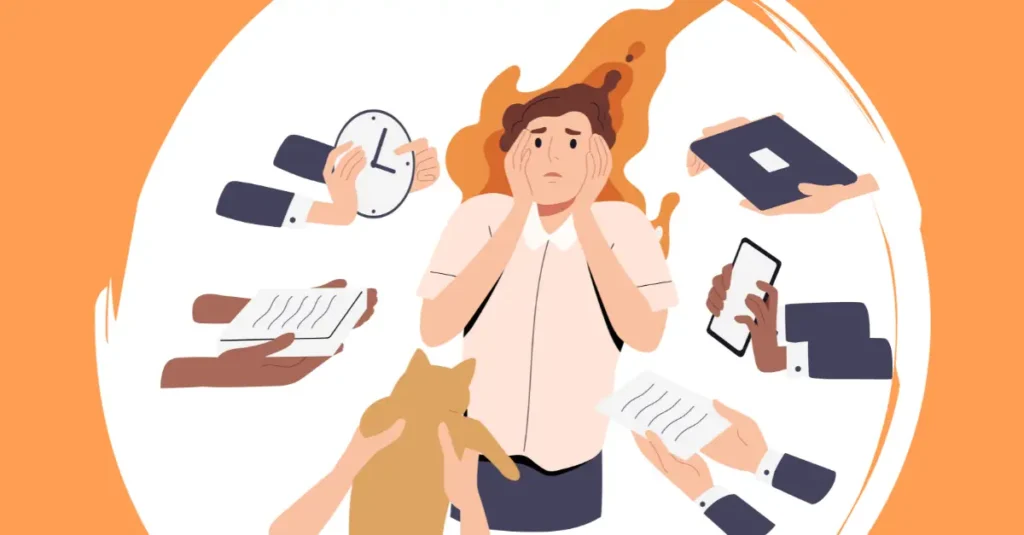
Signs of Catastrophizing: The psychology of catastrophizing, anxiety, cognitive distortions, and why your brain keeps preparing for disasters that haven’t happened.
Let’s start with a completely normal human experience.
Your boss sends:
“Can we talk tomorrow?”
And within three minutes your brain has produced the following storyline:
You’re getting fired.
You’ll never find another job.
You’ll become financially ruined.
You’ll be forced to survive by selling handmade candles online.
The candle business fails.
You move into a cave.
A documentary is eventually made about your downfall.
All because of one text message.
If this sounds familiar, congratulations.
Your brain may be engaging in one of psychology’s favorite cognitive distortions:
Catastrophizing.
The good news is that you’re not losing your mind.
The bad news is that your brain occasionally behaves like a Netflix screenwriter who has been told every story needs more drama.
Understanding the Signs of Catastrophizing can help explain why some people experience enormous anxiety from situations that later turn out to be completely manageable.
Because catastrophizing is not just worrying.
It’s worry with a production budget.
What Is Catastrophizing?
Before discussing the Signs of Catastrophizing, let’s define it.
Catastrophizing is a cognitive distortion where people automatically imagine the worst possible outcome and treat it as the most likely outcome.
The mind jumps from:
“Something might go wrong.”
To:
“Everything will go wrong.”
And then often continues to:
“My entire life is over.”
Cognitive Behavioral Therapy (CBT) identifies catastrophizing as one of the most common thinking errors associated with anxiety.
The problem isn’t caution.
The problem is probability.
Catastrophizing consistently overestimates danger while underestimating coping ability.
1. Small Problems Instantly Become Huge Problems
One of the clearest Signs of Catastrophizing is escalation.
A mistake becomes a disaster.
A delay becomes a crisis.
A disagreement becomes a relationship-ending event.
The brain skips several logical steps and goes directly to the dramatic conclusion.
It’s the psychological equivalent of seeing one raindrop and immediately building an ark.
2. You Treat Possibilities Like Certainties
An important feature of the Signs of Catastrophizing is confusing possibility with probability.
Could you fail the exam?
Sure.
Could your presentation go badly?
Absolutely.
Could someone dislike you?
Of course.
But catastrophizing treats “could happen” as “will definitely happen.”
The brain stops evaluating likelihood and starts writing fiction.
Unfortunately, the genre is always disaster.
3. Your Brain Loves the Phrase “What If?”
If catastrophizing had an official slogan, it would be:
“What if?”
What if I embarrass myself?
What if I fail?
What if I get rejected?
What if something terrible happens?
One of the most recognizable Signs of Catastrophizing is becoming trapped in endless hypothetical scenarios.
The mind generates possibilities faster than reality can disprove them.
4. You Ignore Evidence That Contradicts Your Fear
Catastrophizing has terrible fact-checking skills.
You have succeeded before.
Handled challenges before.
Recovered from mistakes before.
Solved problems before.
Yet the anxious brain conveniently forgets all evidence when constructing a new disaster.
One of the classic Signs of Catastrophizing is selectively focusing on threat while ignoring proof of resilience.
5. Every Setback Feels Permanent
Failed one test?
Career ruined.
Awkward conversation?
Social life destroyed.
Bad date?
You’ll die alone.
One of the more dramatic Signs of Catastrophizing is assuming temporary problems are permanent realities.
Psychologists sometimes call this overgeneralization.
The brain takes one event and turns it into a lifelong prediction.
6. You Constantly Prepare for Emotional Earthquakes
Many people experiencing the Signs of Catastrophizing spend enormous energy preparing for disasters that never occur.
Mentally rehearsing.
Planning.
Overthinking.
Analyzing.
Re-analyzing.
And then analyzing the analysis.
The irony is that most of the feared situations never happen.
But the anxiety feels real because the preparation is real.
7. Reassurance Only Works Temporarily
Someone reassures you.
You feel better.
For approximately twelve minutes.
Then a new catastrophic scenario appears.
One reason the Signs of Catastrophizing become so exhausting is that reassurance treats the symptom rather than the thinking pattern.
The brain simply finds another disaster to worry about.
Why Does the Brain Catastrophize?
Understanding the Signs of Catastrophizing becomes easier when we understand their purpose.
Catastrophizing is not stupidity.
It’s protection.
Anxiety believes:
“If I prepare for the worst, I’ll be safer.”
The brain attempts to reduce uncertainty by imagining every possible threat.
Unfortunately, this often increases anxiety rather than reducing it.
Because now you’re experiencing disasters that haven’t even happened.
The Hidden Problem With Catastrophizing
Here’s what makes the Signs of Catastrophizing particularly tricky.
Sometimes bad things do happen.
That’s what makes the distortion convincing.
The issue is not that catastrophizing is always wrong.
The issue is that it constantly predicts disaster regardless of probability.
A broken clock is right twice a day.
That doesn’t make it reliable.
What CBT Teaches Instead
Cognitive Behavioral Therapy encourages people to challenge catastrophizing with questions like:
What’s the most likely outcome?
What’s the evidence?
Have I handled difficult situations before?
Even if the worst happened, how would I cope?
Notice the last question.
People who catastrophize often underestimate their ability to cope.
The brain becomes obsessed with danger and forgets resilience.
Final Thoughts
The Signs of Catastrophizing are surprisingly common because the brain genuinely believes it’s helping.
It thinks it’s preparing.
Protecting.
Planning.
Keeping you safe.
Instead, it often transforms ordinary life into a never-ending disaster trailer.
The awkward email becomes a career collapse.
The delayed text becomes a relationship crisis.
The small mistake becomes a personal apocalypse.
The next time your brain starts producing its latest disaster movie, pause for a moment.
Ask yourself:
Is this a prediction?
Or is this an audition for the role of Worst-Case Scenario?
Because while catastrophizing is very creative, psychology reminds us of something important:
Your brain is excellent at imagining disasters.
Reality is usually far less dramatic.
And thankfully, reality rarely comes with a soundtrack.
Subscribe to PsychUniverse
Get the latest updates and insights.
Join 3,087 other subscribers!
Niwlikar, B. A. (2026, June 17). Signs of Catastrophizing: Why Your Brain Turns Every Problem Into a Disaster Movie. PsychUniverse. https://psychuniverse.com/signs-of-catastrophizing/