Why Is It Important to Label Your Emotions? Your Brain Can’t Calm What It Can’t Name
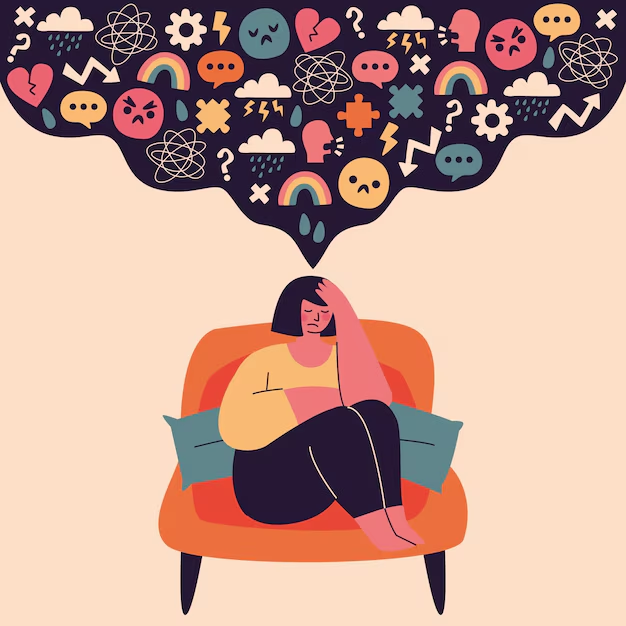
How are you feeling?
Easy question, right?
Now answer it without saying…
“Fine.”
“Okay.”
“Good.”
“Bad.”
Suddenly, it’s not so easy.
Maybe you’re frustrated.
Or disappointed.
Or anxious.
Or overwhelmed.
Or lonely.
Or maybe you’re somehow excited and terrified at the exact same time.
Most of us spend years learning the names of countries, planets, muscles, and even Pokémon.
But when it comes to our own emotions?
We somehow stop at four words.
Happy.
Sad.
Angry.
Fine.
Imagine going to a doctor and saying,
“Something hurts.”
The doctor’s first question would probably be,
“What hurts?”
“Where?”
“How does it feel?”
Because without the right label, finding the right treatment becomes much harder.
Your brain works in a surprisingly similar way.
If every uncomfortable feeling is simply called “stress” or “bad,” your brain struggles to figure out what you actually need.
That’s exactly Why Is It Important to Label Your Emotions.
The more accurately you identify what you’re feeling, the better your brain becomes at responding to it.
And no, this isn’t just motivational advice.
It’s supported by decades of psychological research.

Why Is It Important to Label Your Emotions?
In psychology, the ability to identify and describe your emotions accurately is linked to something called emotional granularity.
It sounds like a complicated term.
The idea is actually simple.
People with high emotional granularity don’t just say,
“I feel bad.”
They might say,
“I’m disappointed.”
“I’m embarrassed.”
“I’m frustrated.”
“I’m anxious.”
“I’m grieving.”
Those words may seem similar.
Psychologically, they’re very different experiences.
And each one calls for a different response.
That’s one of the biggest reasons Why Is It Important to Label Your Emotions.
Because your brain can’t solve a problem it hasn’t clearly identified.
Your Brain Doesn’t Just Feel Emotions. It Interprets Them.
For a long time, scientists believed emotions simply happened to us.
Today, psychological research paints a more fascinating picture.
According to Lisa Feldman Barrett’s Theory of Constructed Emotion, the brain doesn’t merely react to emotions.
It actively constructs them by combining:
- Your bodily sensations.
- Past experiences.
- Memories.
- Context.
- Predictions about what’s happening around you.
Imagine your heart starts racing.
What does it mean?
If you’re about to give a presentation, your brain may label it as anxiety.
If you’re standing in line for a roller coaster, it may label the exact same physical sensation as excitement.
The body is sending similar signals.
The label changes the experience.
This is one reason Why Is It Important to Label Your Emotions.
The way your brain interprets those internal signals influences how you think, behave, and cope.
The Science of “Name It to Tame It”
One of the most fascinating findings in psychology comes from research on affect labeling.
Affect labeling simply means putting feelings into words.
Studies using brain imaging have found that when people accurately name their emotions, activity in the amygdala, the brain’s alarm system, tends to decrease.
At the same time, areas of the prefrontal cortex, responsible for reasoning, planning, and emotional regulation, become more active.
In simple terms…
Naming your feelings can help your thinking brain regain control from your emotional brain.
Psychologist Dr. Matthew Lieberman famously described this idea as “Name it to tame it.”
The emotion doesn’t magically disappear.
But it often becomes less overwhelming.
That’s another powerful answer to Why Is It Important to Label Your Emotions.
Sometimes the first step toward emotional regulation isn’t changing the emotion.
It’s simply identifying it correctly.
“I’m Stressed” Isn’t Always the Right Answer
Think about how often we say,
“I’m stressed.”
But are we?
Sometimes, yes.
Other times, “stress” is just an umbrella word covering something much more specific.
Maybe you’re actually feeling:
- Rejected.
- Guilty.
- Ashamed.
- Lonely.
- Jealous.
- Uncertain.
- Disappointed.
- Overstimulated.
Each emotion carries different information.
If you’re lonely, taking a break from work won’t solve the problem.
If you’re guilty, distracting yourself may only provide temporary relief.
If you’re overwhelmed, what you need might be rest rather than motivation.
That’s exactly Why Is It Important to Label Your Emotions.
The right label often points you toward the right solution.
And the wrong label can leave you trying to fix the wrong problem.
Why Most of Us Struggle to Name Our Emotions
If labeling emotions is so helpful…
Why are so many of us bad at it?
The answer isn’t that we’re emotionally “weak.”
It’s that very few of us were ever taught how.
As children, many of us heard things like:
“Stop crying.”
“Don’t be so sensitive.”
“You’re overreacting.”
What we didn’t often hear was:
“Are you feeling disappointed?”
“Did that make you feel left out?”
“Are you anxious or just uncertain?”
Over time, many people learn to suppress emotions instead of understanding them.
As adults, we know something feels wrong.
We just can’t put a name to it.
That’s another reason Why Is It Important to Label Your Emotions.
You can’t communicate your inner world to others if you don’t understand it yourself.
Better Labels Lead to Better Decisions
Imagine these two situations.
Person A
“I’m angry.”
So they avoid everyone.
Cancel plans.
Snap at people.
Spend the whole day irritated.
Person B
Pauses for a moment.
“Wait… I’m not actually angry.”
“I’m disappointed because I felt ignored.”
Now the solution changes completely.
Instead of picking a fight…
They have a conversation.
The emotion changed.
Or rather…
The label changed.
And because the label changed, the response changed too.
This is one of the biggest reasons Why Is It Important to Label Your Emotions.
Your emotional vocabulary doesn’t just describe your experience.
It shapes your behaviour.
Labeling Emotions Improves Relationships Too
Think about which of these is easier to respond to.
“I’m upset.”
Or…
“I’m feeling hurt because I felt unheard during our conversation.”
The second statement gives the other person something they can actually understand.
Specific emotions create clearer communication.
Vague emotions often create misunderstandings.
Many relationship conflicts aren’t caused by people hiding their feelings.
They’re caused by people not knowing which feeling they’re actually experiencing.
Being able to say,
“I’m embarrassed.”
Instead of,
“I’m angry.”
Can completely change how a conversation unfolds.
That is yet another reason Why Is It Important to Label Your Emotions.
It helps other people understand you more accurately.
How Can You Get Better at Labeling Your Emotions?
Like any skill, emotional awareness improves with practice.
Here are a few psychology-backed strategies:
1. Replace “Fine” With Something More Specific
The next time someone asks how you’re feeling, challenge yourself to go one step further.
Instead of saying:
“I’m okay.”
Ask yourself:
“What kind of okay?”
Maybe you’re relieved.
Hopeful.
Restless.
Overwhelmed.
Curious.
The more specific you become, the more information your brain has to work with.
2. Expand Your Emotional Vocabulary
Most people regularly use only a handful of emotion words.
Try learning new ones.
Instead of “sad,” could it be:
- Disappointed?
- Lonely?
- Grieving?
- Homesick?
- Discouraged?
Instead of “angry,” could it be:
- Frustrated?
- Resentful?
- Irritated?
- Betrayed?
Small changes in language often create big changes in understanding.
3. Pause Before You React
When emotions become intense, our first instinct is often to react immediately.
Instead, pause and ask yourself:
- What happened?
- What am I feeling right now?
- What emotion best describes this experience?
- What is this emotion trying to tell me?
That brief moment of reflection can prevent many impulsive reactions.
Final Thoughts
So, Why Is It Important to Label Your Emotions?
Because emotions aren’t random.
They’re information.
They tell you what matters to you.
What your needs are.
What your values are.
And sometimes, what needs your attention.
The more accurately you identify your emotions, the easier it becomes to understand yourself, communicate with others, and respond instead of simply reacting.
You don’t have to become an expert in psychology overnight.
You just have to become a little more curious about what you’re feeling.
The next time you’re tempted to say,
“I’m fine.”
Pause for a second.
You might discover that you’re not just “fine.”
You might be hopeful.
Disappointed.
Overwhelmed.
Relieved.
Anxious.
Or grateful.
Because every emotion has a story to tell.
The first step toward understanding that story is giving it the right name.
Subscribe to PsychUniverse
Get the latest updates and insights.
Join 3,084 other subscribers!
Niwlikar, B. A. (2026, July 31). Why Is It Important to Label Your Emotions? Your Brain Can’t Calm What It Can’t Name. PsychUniverse. https://psychuniverse.com/why-is-it-important-to-label-your-emotions/