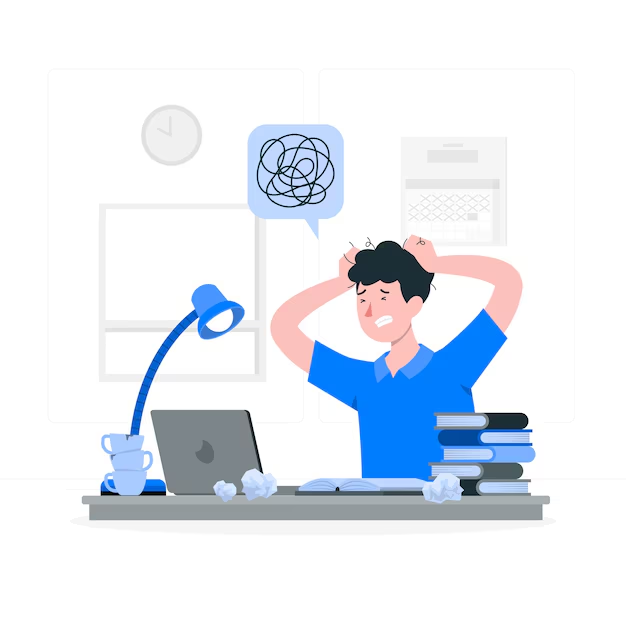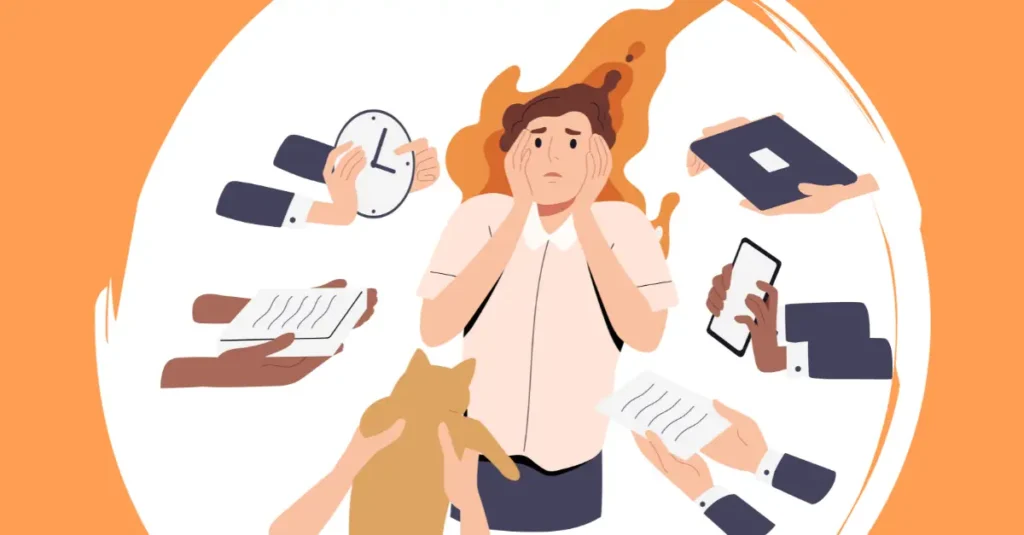
Have you ever spent hours studying, only to forget everything the moment you sit down for the exam? You’re not alone. Many people assume that learning is about time and effort—the longer you study, the more you learn. But psychology and neuroscience tell a very different story.
Learning isn’t about grinding harder; it’s about using strategies that work with your brain instead of against it.
Read More: Sleep and Mental Health
Why “Studying Hard” Often Doesn’t Work
Most of us learned how to study by trial and error. We reread textbooks, highlight notes, cram the night before exams, and hope for the best. These strategies feel productive, but research shows they’re surprisingly ineffective.
One reason is the illusion of learning. When you reread material or highlight text, it feels familiar, so your brain assumes it understands it. But familiarity is not the same as mastery (Bjork, Dunlosky, & Kornell, 2013). You recognize the information—but you can’t necessarily recall or apply it.

Another problem is passive learning. The brain learns best when it’s actively engaged, making connections, retrieving information, and struggling a little. When studying feels too easy, you’re probably not learning much.
How Learning Really Works: A Brain-Based View
Learning happens when your brain strengthens connections between neurons. This process—called synaptic plasticity—is driven by repetition, retrieval, and meaningful engagement (Kandel et al., 2021).
Three key principles guide effective learning:
-
Memory is reconstructive, not reproductive
You don’t “replay” memories like a video. Each time you recall information, you rebuild it—sometimes imperfectly. -
Forgetting is normal and useful
Forgetting isn’t failure; it’s part of learning. The brain prioritizes what it thinks is important, which is why repeated retrieval matters. -
Effort strengthens memory
Learning that feels harder often sticks better—a concept known as desirable difficulties (Bjork & Bjork, 2011).
Evidence-Based Study Strategies That Actually Work
1. Active Recall
Active recall means pulling information out of your memory without looking at your notes. This could involve:
- Flashcards
- Practice questions
- Explaining concepts out loud
- Writing everything you remember on a blank page
Research consistently shows that retrieval practice dramatically improves long-term retention compared to rereading (Roediger & Karpicke, 2006).
Why it works:
Every time you retrieve information, you strengthen the neural pathway associated with it—making future recall easier.
Tip: If studying feels uncomfortable, you’re probably doing it right.
2. Spaced Repetition
Cramming might help you survive a test, but the information fades fast. Spaced repetition—reviewing material over increasing intervals—helps move knowledge into long-term memory.
This phenomenon, called the spacing effect, has been replicated in hundreds of studies (Cepeda et al., 2006).
Instead of studying one topic for hours in one day, try:
- Reviewing it briefly over several days or weeks
- Using apps like Anki or Quizlet with spaced algorithms
Why it works:
Spacing introduces forgetting, which forces your brain to work harder during recall—strengthening memory.
3. Interleaving
Most people study one topic at a time (blocked practice). Interleaving involves mixing related topics or problem types during study sessions.
For example:
- Instead of solving 20 algebra problems in a row, mix algebra, geometry, and word problems.
- Instead of memorizing one psychology theory at a time, compare multiple theories.
Interleaving improves transfer and problem-solving skills, even though it feels more difficult (Dunlosky et al., 2013).
Key insight:
Feeling confused during learning can actually signal deeper processing.
4. Elaboration
Elaboration means connecting new information to what you already know. Ask questions like:
- Why does this work?
- How does this relate to real life?
- Can I explain this in my own words?
Studies show that elaborative interrogation improves comprehension and retention (Pressley et al., 1992).
Example:
Instead of memorizing “dopamine is involved in motivation,” explain how dopamine influences habits, rewards, or social media use.
The Role of Sleep in Learning
Sleep is not optional—it’s a core part of learning.
During sleep, especially deep sleep and REM sleep, the brain:
- Consolidates memories
- Strengthens neural connections
- Integrates new information with existing knowledge
Research shows that students who sleep after studying remember significantly more than those who stay awake (Walker & Stickgold, 2006).
Practical advice:
- Study before sleep for better retention
- Avoid all-night cram sessions
- Aim for consistency, not perfection
Multitasking Is a Learning Killer
Studying while scrolling social media or watching TV feels efficient—but it’s not. The brain doesn’t truly multitask; it switches attention rapidly, which degrades learning.
Heavy media multitaskers show:
- Reduced attention control
- Poorer working memory
- Lower academic performance (Ophir, Nass, & Wagner, 2009)

Bottom line:
Focus beats duration. Thirty minutes of focused study is better than three distracted hours.
Motivation
Many people wait to feel motivated before studying. Psychology suggests the opposite approach works better.
Motivation often follows action—not the other way around. Small wins trigger dopamine release, reinforcing the behavior (Ainslie, 2001).
Smarter strategies:
- Break tasks into tiny steps
- Use time-based goals (e.g., 25 minutes)
- Reward consistency, not outcomes
Studying smarter means designing systems that reduce friction, not relying on willpower.
Growth Mindset and Learning
Your beliefs about intelligence shape how you learn.
A growth mindset—the belief that abilities can improve with effort—has been linked to:
- Greater persistence
- Better academic outcomes
- Higher resilience after failure (Dweck, 2006)
When learners view mistakes as feedback rather than failure, they engage more deeply and learn more effectively.
Try this reframe:
“I don’t understand this yet.”
What Studying Smarter Really Means
Studying smarter isn’t about hacks or shortcuts. It’s about:
- Engaging actively with material
- Embracing productive struggle
- Respecting your brain’s limits
- Using evidence-based strategies
Learning is a skill—and like any skill, it improves with practice and the right tools.
Final Thoughts
The science of learning shows us that effective studying often feels harder—but delivers better results. If your study sessions feel uncomfortable, challenging, and mentally demanding, that’s a good sign.
So next time you’re tempted to reread your notes for the fifth time, pause and ask yourself:
Am I studying in a way that feels easy—or in a way that actually works?
Your brain will thank you later.
References
Ainslie, G. (2001). Breakdown of will. Cambridge University Press.
Bjork, R. A., & Bjork, E. L. (2011). Making things hard on yourself, but in a good way. Psychology and the Real World.
Bjork, R. A., Dunlosky, J., & Kornell, N. (2013). Self-regulated learning. Annual Review of Psychology, 64, 417–444.
Cepeda, N. J., Pashler, H., Vul, E., Wixted, J. T., & Rohrer, D. (2006). Distributed practice in verbal recall tasks. Psychological Bulletin, 132(3), 354–380.
Dunlosky, J., et al. (2013). Improving students’ learning with effective learning techniques. Psychological Science in the Public Interest, 14(1), 4–58.
Dweck, C. S. (2006). Mindset: The new psychology of success. Random House.
Kandel, E. R., et al. (2021). Principles of neural science (6th ed.). McGraw-Hill.
Ophir, E., Nass, C., & Wagner, A. D. (2009). Cognitive control in media multitaskers. PNAS, 106(37), 15583–15587.
Pressley, M., et al. (1992). Elaborative interrogation. Journal of Educational Psychology, 84(2), 237–245.
Roediger, H. L., & Karpicke, J. D. (2006). Test-enhanced learning. Psychological Science, 17(3), 249–255.
Walker, M. P., & Stickgold, R. (2006). Sleep, memory, and plasticity. Annual Review of Psychology, 57, 139–166.
Subscribe to PsychUniverse
Get the latest updates and insights.
Join 3,061 other subscribers!
Niwlikar, B. A. (2026, January 7). The Science of Learning and 3 Powerful Ways It Works. PsychUniverse. https://psychuniverse.com/science-of-learning/