Building good habits is something almost everyone struggles with. Whether it’s committing to daily exercise, reading more, limiting screen time, or eating healthier, forming a new habit can feel like pushing a boulder uphill. Yet the people who seem effortlessly disciplined rarely rely on willpower alone. Instead, they design their behavior using strategic, science-supported methods. One of the most effective—and surprisingly simple—of these strategies is habit stacking.
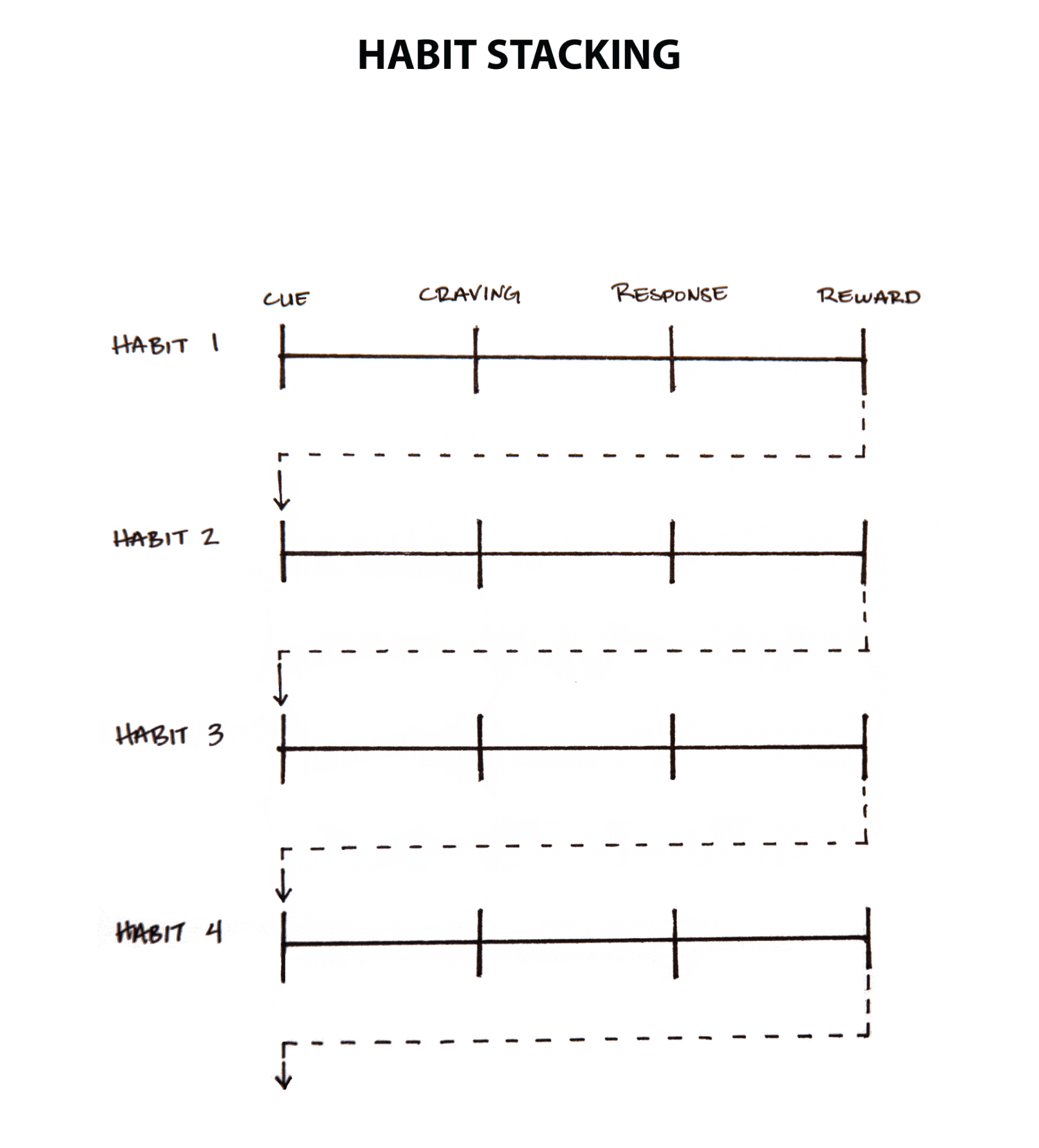
Habit stacking is the practice of linking a new behavior to an existing habit so the brain treats the new action as part of an already familiar routine. The simplicity of this technique is what makes it so powerful. While many habit-building approaches require significant motivation or major life restructuring, habit stacking merges change into your day with minimal resistance. Its effectiveness is backed by behavioral psychology, neuroscience, and decades of research on habit formation.
Read More: Sleep and Mental Health
Why Habits Feel Hard to Build
To understand why habit stacking is so effective, it’s helpful to understand why habits are difficult to create in the first place. A habit is a behavior that has become automatic through repetition, triggered by a cue, leading to a routine, and followed by a reward. Charles Duhigg (2012) refers to this process as the habit loop, emphasizing how cues trigger behavior with little conscious thought.
The challenge is not the behavior itself but the initiation of the behavior. Starting a new habit requires cognitive effort. Your brain must remember the goal, resist other urges, and consciously redirect your behavior. This requires energy, and humans are wired to conserve energy whenever possible. As a result, new habits often fall apart simply because they aren’t naturally triggered by existing cues.
Habit stacking solves this problem by building the cue automatically into your day.
The Psychology Behind Habit Stacking
The psychology behind habit stacking includes:
1. Leveraging Existing Neural Pathways
Neuroscience shows that repeated behaviors strengthen neural pathways, making actions feel automatic (Wood & Rünger, 2016). When you attach a new behavior to a well-established routine—such as brushing your teeth—you take advantage of an already-strong neural pathway. The new behavior piggybacks on the old one, reducing the effort needed to remember or initiate it.
For example:
After I brush my teeth, I will floss one tooth.
This small addition attaches seamlessly to an existing sequence.
2. Reducing Cognitive Load
Cognitive load refers to the mental effort required to perform a task. The more steps your brain must process, the more likely you are to procrastinate or forget. Habit stacking simplifies the process by removing the need for decisions. Instead of thinking, Should I meditate now?, your brain follows a predictable chain: I finished making my coffee. Now I meditate.
As Clear (2018) explains, the easier a behavior is to start, the more likely you are to complete it—and continue completing it over time.
3. Using Environmental Cues to Your Advantage
Environmental cues are powerful triggers. They shape behavior more strongly than motivation alone. Habit stacking creates new associations with cues that are already embedded in your environment, making the new behavior more likely to occur.
For example:
After I sit down at my desk, I will write one sentence.
The desk becomes a cue—not just for work, but specifically for writing.
Small Habits, Big Identity Shifts
One of the most overlooked benefits of habit stacking is how it reshapes identity. Repeated behaviors reinforce identity-based beliefs, such as “I am a person who exercises,” or “I am someone who reads daily.” Over time, these identity shifts increase intrinsic motivation, making you more likely to maintain the behavior (Ryan & Deci, 2000).
Identity-based habits are more powerful than outcome-based goals. Instead of focusing on losing weight or reading 20 books a year, habit stacking promotes behaviors that reinforce the identity you want to build.
For example:
- Reading one page a day reinforces the identity of a reader.
- Doing one push-up reinforces the identity of someone committed to movement.
- Writing one sentence reinforces the identity of a writer.
The behavior may be small, but the psychological impact is significant.
Why Tiny Habits Work Better Than Big Ones
Motivation fluctuates, but structure and environment remain relatively stable. Research on behavior change consistently shows that smaller, more manageable actions lead to greater consistency (Fogg, 2019). Habit stacking relies on the principle of minimal viable effort—the smallest action that moves you toward your desired identity.
Small habits are:
- Easy to start, reducing friction
- Non-threatening to the brain, which avoids big changes
- Sustainable, even on low-energy days
- Momentum-building, creating a sense of progress
This is why habit stacking often feels easier than traditional habit-building strategies.
How to Build a Habit Stack That Works
Here is a step wise breakdown on how to stack habits:
Step 1: Identify an Existing Solid Habit
Choose a habit you already do consistently—daily routines are best. Examples:
- Making coffee
- Taking a shower
- Putting on shoes
- Getting into your car
- Sitting down at your desk
- Brushing your teeth
- Eating meals
This becomes your anchor habit.
Step 2: Choose a Tiny New Behavior
Pick a behavior so small that you cannot fail. Examples:
- One deep breath
- One sentence of journaling
- One minute of stretching
- One push-up
- One page of reading
- One glass of water
The simplicity ensures consistency.
Step 3: Use the “After I…” Formula
Behavioral scientists recommend using the following structure: After I [existing habit], I will [new tiny behavior]. This formula transforms your routine into a predictable sequence. Example: After I pour my morning coffee, I will read one page of a book.
Step 4: Expand Slowly
Once the tiny behavior becomes automatic, you can expand it naturally. Your stack grows organically as you become more comfortable and confident.
Examples of Real-Life Habit Stacks
- After I wake up, I will drink a glass of water.
- After I put on my running shoes, I will stretch for one minute.
- After I sit at my desk, I will write one sentence.
- After I eat lunch, I will take a 5-minute walk.
- After I open my journal, I will write one word.
These simple stacks create consistency and reduce mental resistance.
Habit Stacking in Professional Life
Habit stacking is also powerful in workplace settings. For example:
- After opening your laptop, answer one important email.
- After finishing a meeting, record one takeaway.
- After completing a task, take a 30-second stretch break.
Small workplace habits improve productivity, reduce stress, and increase clarity.
Why Habit Stacking Works Long-Term
Habit stacking is sustainable because it integrates new behaviors into your identity and environment. Instead of fighting for motivation, you rely on structure. Small wins accumulate, and identity shifts reinforce the new behavior. Over time, your automatic routines become the foundation for long-term success.
Conclusion
Habit stacking shows that massive life changes aren’t built on willpower but on small, intentional actions linked to existing routines. By pairing new behaviors with old ones, you create a reliable structure that reduces cognitive load, strengthens your identity, and makes habit formation feel natural. When repeated consistently, even the smallest habits compound into remarkable transformation. Your life doesn’t change from one big effort—it changes from thousands of tiny ones.
References
Clear, J. (2018). Atomic habits. Avery.
Duhigg, C. (2012). The power of habit. Random House.
Fogg, B. J. (2019). Tiny habits: The small changes that change everything. Houghton Mifflin Harcourt.
Ryan, R. M., & Deci, E. L. (2000). Self-determination theory and the facilitation of intrinsic motivation. American Psychologist, 55(1), 68–78.
Wood, W., & Rünger, D. (2016). Psychology of habit. Annual Review of Psychology, 67, 289–314.
Subscribe to PsychUniverse
Get the latest updates and insights.
Join 3,055 other subscribers!
Niwlikar, B. A. (2025, December 6). The Power of Habit Stacking and 3 Powerful Psychological Reasons Behind It. PsychUniverse. https://psychuniverse.com/power-of-habit-stacking/