Why You Still Don’t Know How to Understand Your Emotions
Okay, let’s try something.
A very simple game.
I’ll give you a situation. You tell me how you’d feel.
You open your phone and see someone you care about ignored your message.
What do you feel?
“Bad.”
You worked really hard on something and nobody acknowledged it.
What do you feel?
“Bad.”
Your plans fall apart at the last minute.
What do you feel?
“Bad.”
Now let’s flip it.
You get unexpected good news.
What do you feel?
“Good.”
You spend time with people you like.
What do you feel?
“Good.”
Something finally works out after a long time.
What do you feel?
“Good.”
That’s it.
Bad. Good.
Two words doing the emotional labor of your entire life. If it’s Positive emotions: good, if Negative emotions: bad.
And then you wonder why everything feels confusing, overwhelming, and slightly out of control.
Of course it does.
You’re trying to understand something complex with almost no language for it.
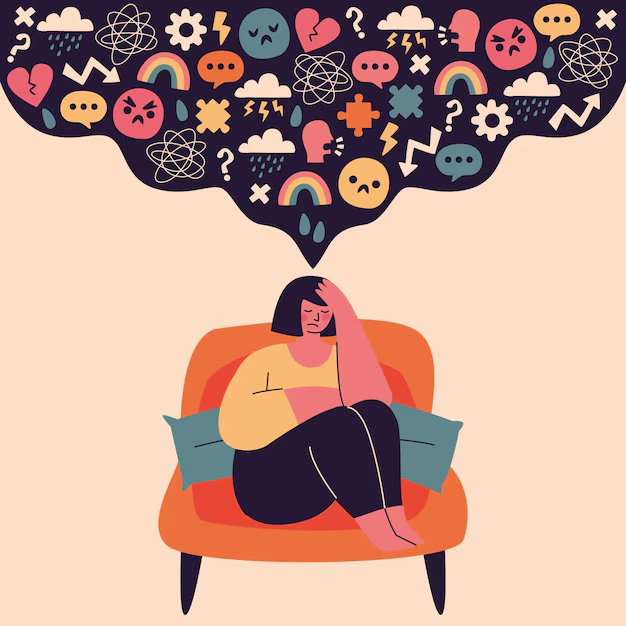
When every uncomfortable experience becomes “bad” and every pleasant one becomes “good,” you lose all nuance. Everything starts to feel bigger than it is, because nothing is clearly defined.
And when nothing is clearly defined, nothing is easy to process.
And this is exactly why you need to learn how to understand your emotions.
So let’s begin your very overdue quest on how to understand your emotions.

The Real Problem Isn’t Your Emotions. It’s Your Language.
Most people assume they struggle emotionally because they “feel too much.”
That sounds convincing, but it misses the point.
What actually creates overwhelm is not intensity, it’s lack of distinction.
When everything is labeled the same way, your internal world becomes blurred. There’s no separation between different experiences, no hierarchy, no clarity.
A slight anxiety about tomorrow feels the same as deep disappointment from something that mattered. Irritation feels identical to anger. Emotional fatigue blends into sadness.
And when everything feels the same, your mind doesn’t know how to respond to any of it properly.
That’s why learning how to understand your emotions is less about control and more about precision.
Emotional Granularity Is the Skill You’ve Been Avoiding
This is where emotional granularity comes in.
Despite the technical name, the idea is straightforward.
It refers to your ability to identify and describe your emotional experiences with specificity.
Not in an exaggerated or overly analytical way.
Just accurately.
Instead of saying, “I feel bad,” you begin to notice:
“I feel anxious about something coming up, slightly disappointed about how that conversation went, and mentally tired.”
That shift from vague to specific is what changes your entire emotional experience.
Because how to understand your emotions depends on how clearly you can define them.
Why Vague Emotions Feel So Heavy
When emotions remain undefined, they don’t stay contained.
They expand.
A small discomfort, when left unnamed, starts influencing your thoughts, your reactions, and your mood. It spreads because it has no boundaries.
This is why “I feel bad” can feel so overwhelming.
Not because the feeling itself is large, but because it’s unclear.
Once you begin to separate it into specific parts, something changes.
The intensity reduces.
Because now you’re not dealing with everything at once.
You’re dealing with something identifiable.
And that’s a key part of how to understand your emotions.
Your Brain Needs Specificity to Function Properly
The brain is capable of regulating emotions effectively, but only when it knows what it’s working with.
If everything is labeled as “bad,” there is no prioritization.
No differentiation.
No direction.
So your responses become broad and often mismatched.
You withdraw when you needed to communicate.
You overthink when you needed clarity.
You distract yourself when something small needed attention.
And then it feels like you’re simply “bad at handling emotions.”
In reality, you haven’t yet developed how to understand your emotions in a way that allows your brain to respond accurately.
Language Doesn’t Just Describe Emotions. It Organizes Them
The way you label an emotion changes how it feels.
“I feel bad” keeps everything vague and expansive.
“I feel anxious about one specific situation” creates boundaries.
The experience becomes more contained, more structured, easier to approach.
This is what emotional granularity does.
It organizes your internal experience.
And once something is organized, it becomes manageable.
Which is why learning how to understand your emotions changes not just your awareness, but your response.
People Who Handle Emotions Well Are More Precise
They’re not necessarily calmer.
They’re not less emotional.
They’re simply more accurate in how they identify what they feel.
They can distinguish between frustration and anger, between disappointment and sadness, between anxiety and anticipation.
These distinctions matter.
Because each emotional state requires a different kind of response.
Without that clarity, everything feels identical.
And when everything feels identical, your reactions become repetitive and ineffective.
This is why emotional granularity plays such an important role in how to understand your emotions.
When You Don’t Name It, It Stays
Unidentified emotions don’t disappear.
They linger.
They influence how you think, how you respond, and how you interact with others.
A small, undefined discomfort can shape your entire day.
Not because it is intense, but because it remains unprocessed.
Naming an emotion gives it structure.
It allows it to be addressed.
And often, that alone reduces its intensity.
This is one of the simplest but most powerful aspects of how to understand your emotions.
With Emotional Granularity, Emotions Become Useful
When you start identifying emotions more precisely, they stop feeling overwhelming.
They start functioning as information.
You begin to see patterns.
You understand triggers.
You respond with more intention rather than reacting automatically.
This is the practical value of emotional granularity.
It doesn’t remove emotions.
It makes them usable.
And that is central to learning how to understand your emotions.
Final Thoughts
The issue was never that you feel too much.
It’s that you’ve been trying to understand a complex emotional system with extremely limited language.
Bad. Good.
That’s not enough.
And until that changes, everything will continue to feel heavier than it needs to be.
Because confusion amplifies emotion.
Clarity contains it.
So the next time you say, “I feel bad,” pause.
There is always something more specific underneath that.
Something that can be named, understood, and responded to.
And that is where you begin to truly learn how to understand your emotions.
Subscribe to PsychUniverse
Get the latest updates and insights.
Join 3,061 other subscribers!
Niwlikar, B. A. (2026, April 8). 3 Uncomfortable Truths About Emotional Granularity: Why You Still Don’t Know How to Understand Your Emotions. PsychUniverse. https://psychuniverse.com/how-to-understand-your-emotions/