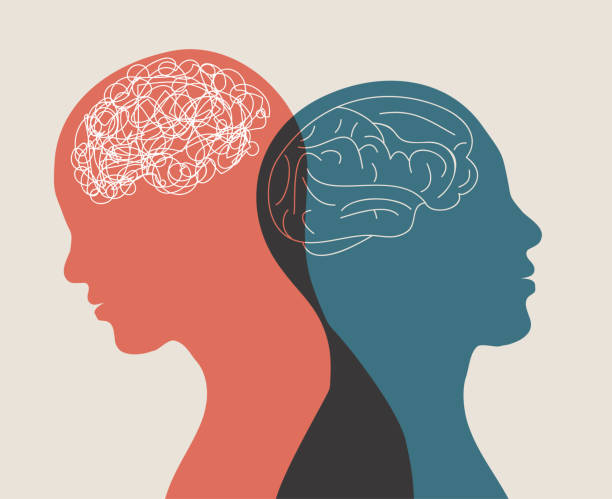
Cognitive Behavioral Therapy (CBT) is one of the most widely researched and practiced forms of psychotherapy in the world. Endorsed by major health organizations and used across cultures, CBT is often considered the gold standard treatment for anxiety, depression, and many other psychological disorders.
But what exactly makes CBT so effective? Why does a structured, time-limited therapy outperform many unstructured approaches? And how does changing thoughts lead to lasting emotional and behavioral change?
Read More: Sleep and Mental Health
The Core Idea Behind Cognitive Behavioral Therapy
CBT is based on a deceptively simple principle:
Thoughts, emotions, and behaviors are interconnected—and changing one can change the others.
This idea originates from Aaron Beck’s cognitive model, which proposed that psychological distress arises not directly from events, but from interpretations of those events (Beck, 1976).
CBT does not deny pain or trauma. Instead, it examines how meaning is constructed.
Automatic Thoughts and Core Beliefs
CBT identifies two key cognitive layers:
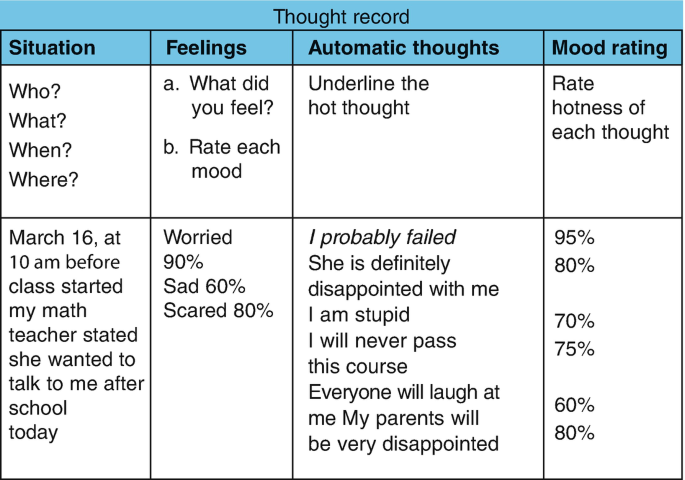
1. Automatic Thoughts
Quick, habitual thoughts that arise in response to situations.
Example:
“I messed up. Everyone thinks I’m incompetent.”
2. Core Beliefs
Deeply held assumptions about the self, others, and the world.
Examples:
- “I am unlovable.”
- “The world is dangerous.”
- “I must be perfect to be accepted.”
CBT works by identifying, questioning, and restructuring these beliefs.
Cognitive Distortions
CBT research has identified common distortions, including:
- catastrophizing
- overgeneralization
- black-and-white thinking
- personalization
- emotional reasoning
These distortions are universal—not pathological. CBT teaches clients to recognize them without judgment.

Why Challenging Thoughts Works
When distorted thoughts are treated as facts, the brain activates stress responses. By evaluating thoughts rationally, CBT engages the prefrontal cortex, improving emotional regulation.
Neuroimaging studies show CBT increases activity in executive control regions while reducing limbic reactivity (Goldapple et al., 2004).
Behavioral Experiments
CBT emphasizes action, not insight alone. Behavioral experiments test beliefs in real life.
Example:
Belief: “If I speak up, I’ll be rejected.”
Experiment: Speak briefly in a meeting and observe the outcome.
These experiments produce corrective emotional experiences that reshape beliefs more effectively than reassurance.
CBT and Exposure Therapy
For anxiety disorders, exposure is one of CBT’s most powerful tools. Avoidance maintains fear. Exposure teaches the brain that feared outcomes do not occur—or are survivable.
Exposure works by:
- reducing threat sensitivity
- increasing tolerance of distress
- retraining fear circuitry
CBT Is Structured and Goal-Oriented
CBT differs from insight-oriented therapies in that it is:
- time-limited
- skills-based
- collaborative
- measurable
Clients actively practice skills between sessions, accelerating progress.
CBT’s Strong Evidence Base
CBT has been shown effective for:
- depression
- anxiety disorders
- OCD
- PTSD
- eating disorders
- insomnia
- chronic pain
- substance use disorders
Meta-analyses consistently demonstrate CBT’s superiority or equivalence to medication—with longer-lasting effects after treatment ends (Hofmann et al., 2012).
CBT and Emotional Regulation
CBT improves emotional regulation by teaching:
- cognitive flexibility
- distress tolerance
- problem-solving skills
- realistic self-talk
These skills generalize beyond therapy.
Limitations and Misconceptions
CBT is sometimes criticized as:
- too “logical”
- emotionally detached
- surface-level
In reality, modern CBT integrates emotion, trauma, and mindfulness. However, CBT is not ideal for everyone, and therapist skill matters significantly.
CBT in Modern Practice
Contemporary CBT includes:
- acceptance and commitment therapy (ACT)
- dialectical behavior therapy (DBT)
- mindfulness-based CBT
- trauma-focused CBT
These approaches preserve CBT’s core while expanding flexibility.
Conclusion
CBT works because it aligns with how the brain learns. By targeting thought patterns, emotional responses, and behaviors simultaneously, CBT creates lasting change. It empowers individuals not just to feel better—but to think differently, act effectively, and respond flexibly to life’s challenges.
CBT is not about positive thinking. It is about accurate thinking, compassionate self-understanding, and evidence-based change.
References
Beck, A. T. (1976). Cognitive Therapy and the Emotional Disorders.
Goldapple, K., et al. (2004). Modulation of cortical-limbic pathways in depression. Archives of General Psychiatry.
Hofmann, S. G., et al. (2012). The efficacy of cognitive behavioral therapy. Cognitive Therapy and Research.
Butler, A. C., et al. (2006). The empirical status of CBT. Clinical Psychology Review.
Subscribe to PsychUniverse
Get the latest updates and insights.
Join 3,049 other subscribers!
Niwlikar, B. A. (2025, December 16). Cognitive Behavioral Therapy Explained With 2 Important Principles. PsychUniverse. https://psychuniverse.com/cognitive-behavioral-therapy/