Congratulations.
Out of all the things your brain could do at 2:37 AM like, I don’t know, sleep, recover, repair your body, consolidate memories, act like a normal functioning organ…
…it chooses to remind you of that one time you waved back at someone who wasn’t waving at you.
Elite performance.
Truly.
You’re lying there, eyes closed, trying to rest, and your brain suddenly goes,
“Quick recap before we sleep. Let’s revisit every embarrassing moment since 2009.”
And just like that, you’re wide awake. Heart slightly racing. Face scrunched. Mentally screaming “WHY did I do that?”
And the best part?
You’re not fixing anything. You’re not learning anything. You’re just… replaying it. Like a low-budget Netflix series with one episode and zero character development.
You call it over thinking.
Your brain calls it “processing.”
Psychology calls it rumination.
And if you actually want to figure out how to stop rumination, you first need to understand why your brain is this obsessed with humiliating you at 2:37 AM.

What Exactly Is Rumination?
Rumination is not deep thinking. It’s not reflection. It’s not “I’m just trying to understand myself.”
Rumination is when your brain takes one negative thought and says,
“Perfect. Let’s stay here forever.”
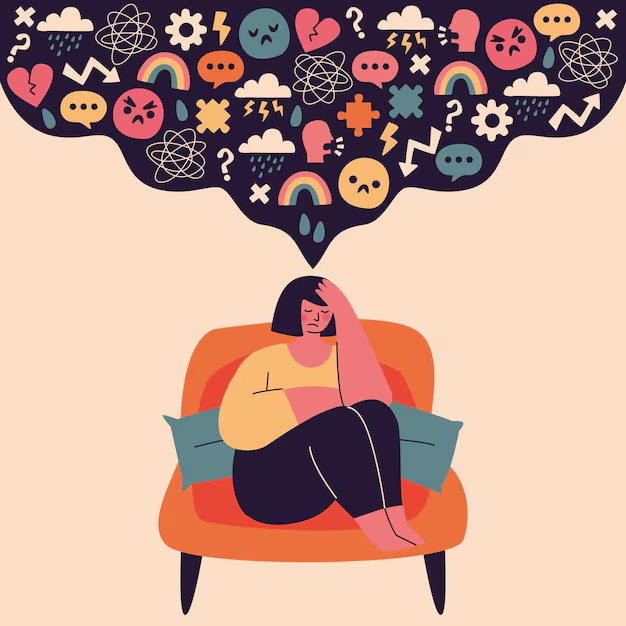
It’s a repetitive cognitive loop where the same thought, memory, or mistake plays on repeat without reaching any conclusion.
No resolution.
No clarity.
Just vibes. Bad ones.
In psychology, this is part of repetitive negative thinking, a pattern strongly linked to anxiety and depression. Your brain keeps circling the same content without actually solving anything.
So when you’ve been replaying that one awkward conversation for 20 minutes, you’re not analyzing.
You’re stuck.
And recognizing that is step one in understanding how to stop rumination.
Why Your Brain Thinks This Is a Good Idea
Here’s the slightly annoying truth.
Your brain genuinely believes it’s helping.
Rumination is your brain’s attempt at problem-solving. It thinks, “If we go over this again, maybe we’ll find the perfect response we should have said.”
Your brain is basically trying to rewrite the past.
Bold strategy.
From a neuroscience perspective, this involves the default mode network, the system responsible for self-focused thinking. This network becomes more active when you’re not distracted, which is why nighttime is prime overthinking hours.
No noise.
No distractions.
Just you and your brain deciding to revisit your greatest hits of embarrassment.
At the same time, your amygdala, the emotional center of the brain, gets activated when you recall these memories. And here’s the fun part.
Your brain doesn’t fully distinguish between past and present emotional experiences.
So when you remember that embarrassing moment, your body reacts like it’s happening again.
Same discomfort.
Same cringe.
Same “I need to disappear immediately” energy.
Your brain then goes, “Wow, this feels important. Let’s think about it more.”
And that’s how the loop tightens.
Which is exactly why understanding the mechanism is key if you want to learn how to stop rumination.
Why It’s Always the Most Embarrassing Stuff
Quick question.
Why is it never, “Wow, remember that time you did something amazing?”
No. It’s always, “Remember when you said ‘you too’ to the waiter who said ‘enjoy your meal’?”
That’s because of the brain’s negativity bias.
Your brain is wired to prioritize negative experiences because, evolutionarily, they were more important for survival. Mistakes meant danger. Embarrassment meant social rejection.
So your brain stores these moments with extra emotional weight.
Which means they’re easier to recall. And once recalled, they’re more likely to trigger rumination.
So yes, your brain is biased.
Not against the world.
Against your peace.
Understanding this bias is another important step in figuring out how to stop rumination.
Why Rumination Feels Productive (But Isn’t)
Here’s the trap.
Rumination feels like you’re doing something useful.
You’re thinking. You’re analyzing. You’re revisiting details.
It feels like effort.
But psychologically, rumination is unproductive repetition, not problem-solving.
Your brain stays in an abstract, emotional loop instead of shifting to concrete solutions.
This keeps your stress response active. Cortisol levels can remain elevated. Your nervous system doesn’t fully relax.
Which is why after 30 minutes of overthinking, you feel worse, not better.
And yet, your brain is like, “Let’s go again.”
This is why learning how to stop rumination is not just about “thinking less.” It’s about thinking differently.
So, How Do You Actually Stop Rumination?
Now comes the part your brain will resist.
Because breaking rumination means stepping out of the loop it’s very committed to.
1. Call It Out
First, stop romanticizing it.
You’re not “deeply reflecting.” You’re looping.
Labeling it as rumination creates cognitive distance. It activates the rational part of your brain and reduces emotional intensity.
A simple, “Oh, this is rumination,” can interrupt the cycle.
Yes, your brain will try to continue anyway. Stay firm.
This is step one in how to stop rumination.
2. Stop Asking “Why”
Rumination thrives on “why.”
“Why did I say that?”
“Why am I like this?”
“Why am I so embarrassing?”
These questions have no satisfying answers. Your brain just keeps digging.
Switch to “what.”
“What can I do differently next time?”
“What actually matters right now?”
This shifts your brain from emotional looping to goal-directed thinking.
A very underrated technique in how to stop rumination.
3. Break the State Physically
Your brain is stuck in a loop, but your body can break it.
Stand up. Walk. Stretch. Drink water. Change rooms.
This is called behavioral activation. It disrupts the neural pattern associated with rumination and forces your brain to shift attention.
Yes, it sounds basic.
Yes, it works.
4. Set a “Worry Window”
Instead of letting rumination take over your entire day, give it a specific time slot.
10 to 15 minutes.
Let your brain do its thing then.
Outside that window, you delay the thought.
This trains your brain that rumination is not allowed to run 24/7.
A practical and effective method in learning how to stop rumination.
5. Accept That You’re Not Getting a Perfect Ending
Your brain wants closure.
It wants the perfect line you should have said. The perfect reaction. The perfect version of you.
That version does not exist.
Most social situations are messy, imperfect, and forgettable to everyone except you.
Accepting this reduces the need for your brain to keep replaying the moment.
And honestly, this is one of the most important parts of how to stop rumination.
Final Thoughts
Your brain is not broken.
It’s just… dramatic.
It takes one awkward moment and turns it into a full psychological thriller at 2:37 AM.
Rumination feels like thinking. It feels important. It feels urgent.
But it’s just repetition.
Understanding how to stop rumination means recognizing the loop, stepping out of it, and refusing to rewatch the same episode for the hundredth time.
Because at some point, it’s not analysis anymore.
It’s just bad programming.
And you don’t have to keep running it.
Subscribe to PsychUniverse
Get the latest updates and insights.
Join 3,088 other subscribers!
Niwlikar, B. A. (2026, March 19). Why Your Mind Brings Up Old Embarrassments at 2:37 AM (The Brutal Truth About How to Stop Rumination). PsychUniverse. https://psychuniverse.com/the-brutal-truth-about-how-to-stop-rumination/