Let’s be honest.
How long do you think you’ll actually stay with this article?
Be realistic. Two minutes? Three?
Or are you already planning the next app you’ll open before you even reach the middle?
If you don’t finish this, it won’t be because it’s boring. It’ll be because of the brutal, alarming effects of scrolling on attention span.
And yes, I said brutal.
Because we love pretending, we’re in control.
“I can stop anytime.”
“It’s just how I relax.”
“Everyone scrolls.”
Sure. And everyone eats sugar too. That doesn’t mean it’s not melting something important.
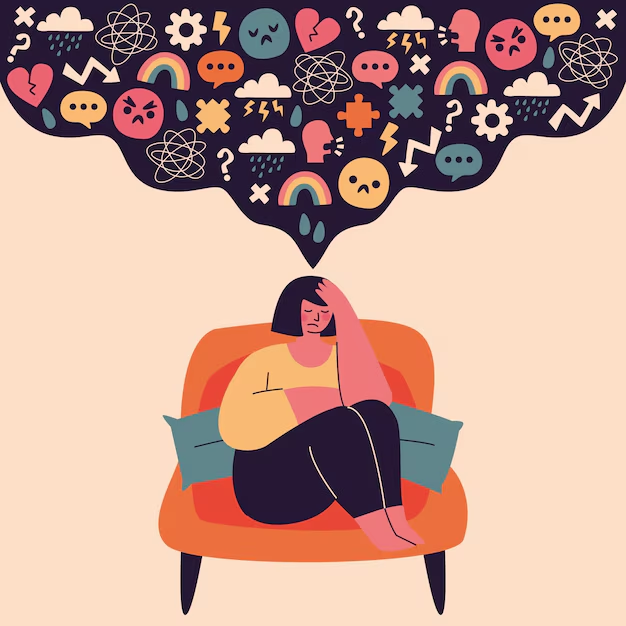
Your brain has been trained to expect constant novelty. Constant movement. Constant reward. So, when something doesn’t instantly stimulate you, it feels slow. Heavy. Almost irritating.
And if, while reading this, your brain whispers, “Maybe just one quick scroll…”
Congratulations.
You’re Exhibit A in today’s autopsy.
We need to talk about the brutal, alarming effects of scrolling on attention span. Not the cute version. Not the “it’s just a bad habit” version. The real one. The one that explains why sitting with one idea now feels like a psychological endurance test.
Let’s dissect it.

Your Brain Wasn’t Designed for Infinite Stimulus
Your brain evolved to pay attention to meaningful change, a sound in the bushes, a shift in facial expression, a movement in your peripheral vision. Attention is energy expensive. It’s selective by design. But scrolling hijacks that system.
Every swipe is a slot machine pull. New face. New drama. New opinion. New outrage. New dopamine hit.
The effects of scrolling on attention span begin with this constant novelty. Your brain adapts to rapid-fire stimulation. It recalibrates what “normal” stimulation feels like. Suddenly, reading a book feels slow. A lecture feels unbearable. A conversation without notifications feels like psychological starvation.
It’s not that you “don’t feel like focusing.” It’s that your brain has been trained to expect fireworks every three seconds.
That’s one of the first brutal effects of scrolling on attention span. It raises your stimulation threshold. Ordinary life starts feeling underwhelming.
Dopamine Is Not Your Friend Here
Let’s clear something up: dopamine is not happiness. It’s anticipation.
Scrolling is engineered anticipation. You don’t know what’s coming next. That uncertainty? Addictive. Your brain learns: Swipe = possible reward.
Now imagine doing this hundreds of times a day.
The cumulative effects of scrolling on attention span start looking like this:
-
Reduced tolerance for delayed gratification
-
Increased distractibility
-
Compulsive task-switching
-
Mental restlessness
When you try to work, your brain goes, “Where’s the novelty? Where’s the reward? Why is this document not entertaining me?”
Because it’s a document. Not a digital casino.
One of the most alarming effects of scrolling on attention span is how it fragments your cognitive endurance. Deep focus, what psychologists call sustained attention, requires monotony tolerance. Scrolling destroys monotony tolerance.
And then we wonder why five uninterrupted minutes feel like a marathon.
Attention Residue: The Invisible Leak
Here’s something most people don’t realize.
Every time you switch tasks from work to notification to message to reel, a part of your attention stays stuck on the previous stimulus. This is called attention residue.
The effects of scrolling on attention span are amplified because scrolling is micro task-switching at extreme speed. You’re emotionally reacting to 20 different stimuli in two minutes. Politics. Humor. Body image. Productivity hacks. Breakups. Cat videos.
Your brain doesn’t neatly file those away. It carries residue.
So when you sit down to concentrate, you’re not starting at 100% focus. You’re starting at 63%, with leftover emotional noise.
That mental fog you call “burnout”?
Sometimes it’s just overstimulation.
Another one of the subtle but brutal effects of scrolling on attention span is cognitive fragmentation. Your thoughts become shorter. More reactive. Less reflective.
You stop thinking deeply. You start thinking in captions.
Your Brain Is Being Rewired
Neuroplasticity is real. Your brain changes based on repeated behavior.
If you repeatedly train it to:
-
Process fast-moving visual stimuli
-
Shift attention rapidly
-
Seek novelty constantly
-
Abandon content quickly
Guess what it gets good at?
Exactly that.
The long-term effects of scrolling on attention span include structural and functional shifts in how attention networks operate. The prefrontal cortex, responsible for executive control and sustained focus, competes with reward circuitry that’s constantly being triggered.
You’re not “bad at focusing.”
You’re over-trained at not focusing.
And that’s the most dangerous part of the effects of scrolling on attention span. They feel like personality traits. “I’ve always been like this.” No. You’ve been conditioned like this.
Why Silence Feels Uncomfortable Now
Have you noticed that silence feels louder?
No background noise. No screen. No scrolling.
Just you and your thoughts.
Uncomfortable, right?
The effects of scrolling on attention span also include reduced internal tolerance. When your mind is constantly externally stimulated, it loses comfort with internal processing. Reflection feels boring. Daydreaming feels pointless.
But reflection is where insight happens. Creativity requires boredom. Deep thinking requires stillness.
Scrolling replaces stillness with stimulus.
The effects of scrolling on attention span don’t just reduce productivity, they shrink introspection.
And that should scare you a little.
The Illusion of Multitasking
You think you’re multitasking. You’re not. You’re rapidly switching.
The cognitive cost of that switching is enormous. Research consistently shows task-switching reduces efficiency and increases error rates.
The effects of scrolling on attention span intensify this pattern. Your brain becomes primed for interruption. You start interrupting yourself.
Mid-sentence? Check phone.
Mid-thought? Open another tab.
Mid-conversation? Quick glance at notifications.
It’s not harmless. It’s rewiring.
And the most brutal effects of scrolling on attention span show up when you try to do something meaningful… study, build, write, connect. Suddenly your mind feels slippery. Unstable.
Like it doesn’t want to stay.
Final Diagnosis
Alright. Gloves on. Clipboard out.
Based on the symptoms presented:
-
Inability to focus without external stimulation
-
Compulsive urge to check your phone mid-task
-
Restlessness during silence
-
Reduced tolerance for boredom
-
Fragmented thinking
-
Emotional reactivity to trivial digital triggers
Diagnosis?
You have low attention span. And high scrolling stamina.
Yes, both.
You struggle to sustain focus on one meaningful task, that’s the low attention span part. But you can scroll endlessly without fatigue, that’s the high scrolling stamina part. That contrast is not personality. It’s conditioning.
The effects of scrolling on attention span don’t eliminate your ability to focus. They redirect it. You’ve trained your brain to focus on novelty, not depth. On movement, not meaning. On stimulation, not stillness.
And the longer this pattern continues, the more “normal” distraction feels.
Here’s the uncomfortable truth:
Your attention span isn’t collapsing randomly. It’s being eroded strategically.
The brutal reality of the effects of scrolling on attention span is that they slowly reduce your cognitive endurance while convincing you nothing is wrong. You just think you’re “lazy.” Or “bad at concentrating.” Or “wired differently.”
No.
You are adapted to a high-stimulation environment.
But adaptation can be reversed.
Your brain built this pattern through repetition. It can rebuild focus through repetition too. Depth is a skill. Attention is trainable. Boredom is survivable.
The real question isn’t whether the effects of scrolling on attention span are real.
The real question is whether you’re willing to sit in silence long enough to undo them.
Put the phone down.
If that sentence made you uncomfortable, you already know the diagnosis was accurate.
Autopsy closed.
Subscribe to PsychUniverse
Get the latest updates and insights.
Join 3,084 other subscribers!
Niwlikar, B. A. (2026, March 3). Your Attention Span Is Dying. This Is the Autopsy: The Brutal, Alarming Effects of Scrolling on Attention Span No One Wants to Admit. PsychUniverse. https://psychuniverse.com/brutal-effects-of-scrolling-on-attention-span/