
Introduction
Conflict is inevitable in human relationships. What differs is not whether conflict occurs, but how people respond to it. Some confront issues directly, others withdraw, and some escalate emotionally. These responses are known as conflict styles, and they are deeply shaped by early experiences, personality, and emotional regulation patterns.
Understanding conflict styles helps explain why arguments repeat, why certain disagreements feel overwhelming, and how destructive patterns can be replaced with healthier communication.
Read More: Sleep and Mental Health
What Are Conflict Styles?
Conflict styles refer to habitual ways individuals respond to disagreement or emotional tension. They are not fixed traits but learned strategies that once served a protective purpose.

Conflict styles are influenced by:
- Family communication patterns
- Attachment styles
- Cultural norms
- Temperament
- Past relational trauma
Psychologists note that people often default to conflict behaviors that helped them maintain safety or connection earlier in life (Gottman, 1994).
The Five Common Conflict Styles
The five conflict resolution styles include:

1. Avoidant
Avoidant individuals minimize or evade conflict. They may shut down, change the subject, or physically leave.
- Strengths: Prevents escalation and useful for minor issues
- Costs: Unresolved problems, emotional distance, and partner frustration
Avoidance often develops in environments where conflict felt unsafe or pointless.
2. Accommodating
Accommodators prioritize harmony over personal needs. They may agree outwardly while suppressing resentment.
- Strengths: Reduces immediate tension and shows empathy
- Costs: Loss of authenticity, passive resentment, and power imbalance
This style often forms in families where approval depended on compliance.
3. Competitive (Confrontational)
Competitive conflict involves asserting one’s position strongly, sometimes aggressively.
- Strengths: Clear expression of needs and decisiveness
- Costs: Escalation, emotional injury, and reduced trust
This style is often learned in environments where dominance ensured safety or respect.
4. Compromising
Compromisers seek middle ground and mutual concession.
- Strengths: Fairness and efficiency
- Costs: Surface-level resolution and needs may remain unmet
5. Collaborative
Collaboration focuses on understanding underlying needs and finding mutually satisfying solutions.
- Strengths: Deep connection and long-term resolution
- Costs: Requires emotional maturity and time-intensive
This style is linked to secure attachment and emotional regulation skills.
Why Conflict Feels So Intense
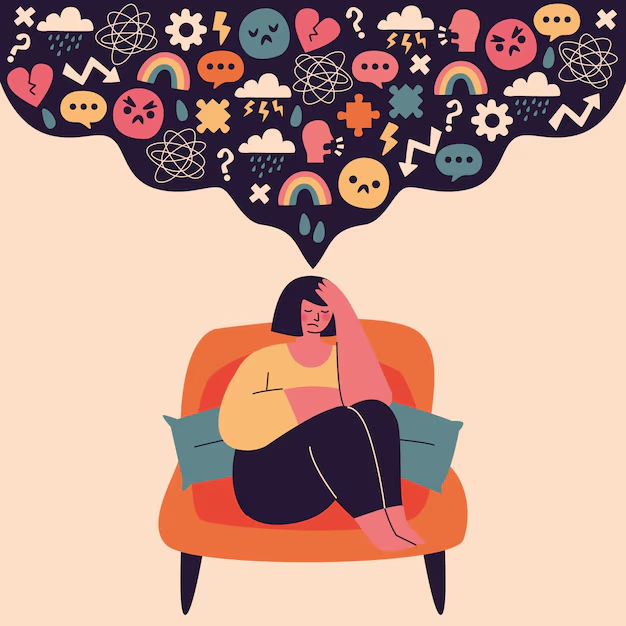
Conflict activates the brain’s threat system, particularly the amygdala. When perceived as emotional danger, the body prepares for fight, flight, or freeze.

Physiological signs include:
- Increased heart rate
- Shallow breathing
- Cognitive narrowing
Once flooded, productive communication becomes nearly impossible (Gottman & Levenson, 1992).
How Conflict Styles Are Reinforced
Conflict styles persist because they work in the short term:
- Avoidance reduces anxiety
- Aggression creates control
- Accommodation maintains approval
Unfortunately, short-term relief often leads to long-term relational damage.
Changing Conflict Styles
Some ways to change conflict styles includes:
- Build Emotional Awareness: Notice physical signs of activation. Naming emotions reduces their intensity and restores cognitive control.
- Slow Down the Nervous System: Techniques such as deep breathing, grounding, and taking breaks help prevent emotional flooding.
- Replace Reactivity with Curiosity: Asking “What is this really about?” shifts conflict from blame to understanding.
- Use “I” Statements: Expressing needs without accusation reduces defensiveness.
- Learn Repair Skills: Apologies, humor, and validation help restore connection after conflict.
The Role of Therapy and Skill-Building
Couples and individual therapy can help:
- Identify unconscious patterns
- Practice new responses
- Develop emotional regulation skills
Emotionally Focused Therapy and Gottman-based approaches show strong evidence for improving conflict outcomes (Johnson & Greenberg, 1985; Gottman, 1999).
Conflict as Opportunity
Healthy conflict strengthens trust, intimacy, and mutual respect. The goal is not to eliminate disagreement but to engage it safely.
When conflict styles shift from defense to dialogue, relationships become spaces for growth rather than threat.
References
Gottman, J. M. (1994). What predicts divorce? Hillsdale, NJ: Erlbaum.
Gottman, J. M. (1999). The marriage clinic. New York: Norton.
Gottman, J. M., & Levenson, R. W. (1992). Marital processes predictive of later dissolution. Journal of Personality and Social Psychology, 63(2), 221–233.
Johnson, S. M., & Greenberg, L. S. (1985). Emotionally focused couples therapy. Journal of Marital and Family Therapy, 11(3), 313–317.
Siegel, D. J. (2012). The developing mind. New York: Guilford Press.
Subscribe to PsychUniverse
Get the latest updates and insights.
Join 3,088 other subscribers!
Niwlikar, B. A. (2026, January 18). How Conflict Styles Develop and 5 Important Conflict Resolution Styles. PsychUniverse. https://psychuniverse.com/conflict-styles/
Pingback: They Need 48 Hours Alone. You Need 48 Text Messages: When 2 Different Attachment Styles Date, It’s About to Be Dramatic.