Introduction
Imagine sitting in a classroom where everyone confidently gives the same wrong answer to a simple question. You know the answer is incorrect. You feel it. Yet when it’s your turn, you hesitate—and then say the same wrong answer as everyone else.
Why?
This unsettling experience is not hypothetical. It has been repeatedly demonstrated in psychological research. Conformity—the act of aligning one’s beliefs, attitudes, or behaviors with those of a group—is one of the most powerful and puzzling forces shaping human behavior. Even when people know better, they often conform.
Read More: Teenagers and Risk
What Is Conformity?
It occurs when an individual changes their behavior, opinions, or beliefs to match those of a group. This change may be explicit (openly agreeing) or implicit (privately adjusting beliefs).
Psychologists distinguish it from:
- Compliance (changing behavior due to a direct request)
- Obedience (following orders from authority)
Conformity often happens without coercion, making it especially powerful (Cialdini & Goldstein, 2004).
The Evolutionary Roots of Conformity
From an evolutionary perspective, it makes sense. Early humans survived by staying within groups. Being excluded from the group could mean death. As a result, humans evolved a strong sensitivity to social acceptance.
Conforming helped:
- Maintain group cohesion
- Reduce conflict
- Increase chances of survival
Our brains still carry this ancient wiring. Even today, social rejection activates the same neural pathways as physical pain (Eisenberger et al., 2003).
The Two Main Types of Conformity
The type main types of it include:
1. Normative Social Influence
Normative conformity occurs when people conform to be liked, accepted, or avoid rejection. Here, the person knows the group is wrong but goes along anyway. Example:
- Laughing at a joke you don’t find funny
- Agreeing with coworkers to avoid standing out
This type of conformity is driven by fear of social consequences, not belief change.
2. Informational Social Influence
Informational conformity occurs when people assume the group knows better than they do, especially in ambiguous situations. Example:
- Following others during an emergency
- Accepting majority opinions in unfamiliar topics
Here, conformity happens because the individual doubts their own judgment.
The Asch Conformity Experiments
One of the most famous demonstrations of conformity comes from Solomon Asch’s experiments in the 1950s.
Participants were asked to identify which of three lines matched a reference line in length—a very simple task. Unknown to the participant, the rest of the group were confederates instructed to give the wrong answer.
The Results
- 75% of participants conformed at least once
- Participants gave wrong answers even when the correct answer was obvious
- When alone, error rates dropped to near zero (Asch, 1955)
Why Did They Conform?
Participants later reported:
- Fear of standing out
- Concern about being seen as stupid
- Desire to avoid conflict
This experiment showed that knowledge alone does not protect against it.
The Role of Group Size and Unanimity
Conformity increases when:
- The group has 3–5 people
- The group is unanimous
- The individual has no ally

Interestingly, when just one person dissents, it drops dramatically (Asch, 1955). This highlights how powerful even minimal social support can be.
Brain Mechanisms Behind Conformity
Neuroscience research suggests it is not merely social—it’s neurological.
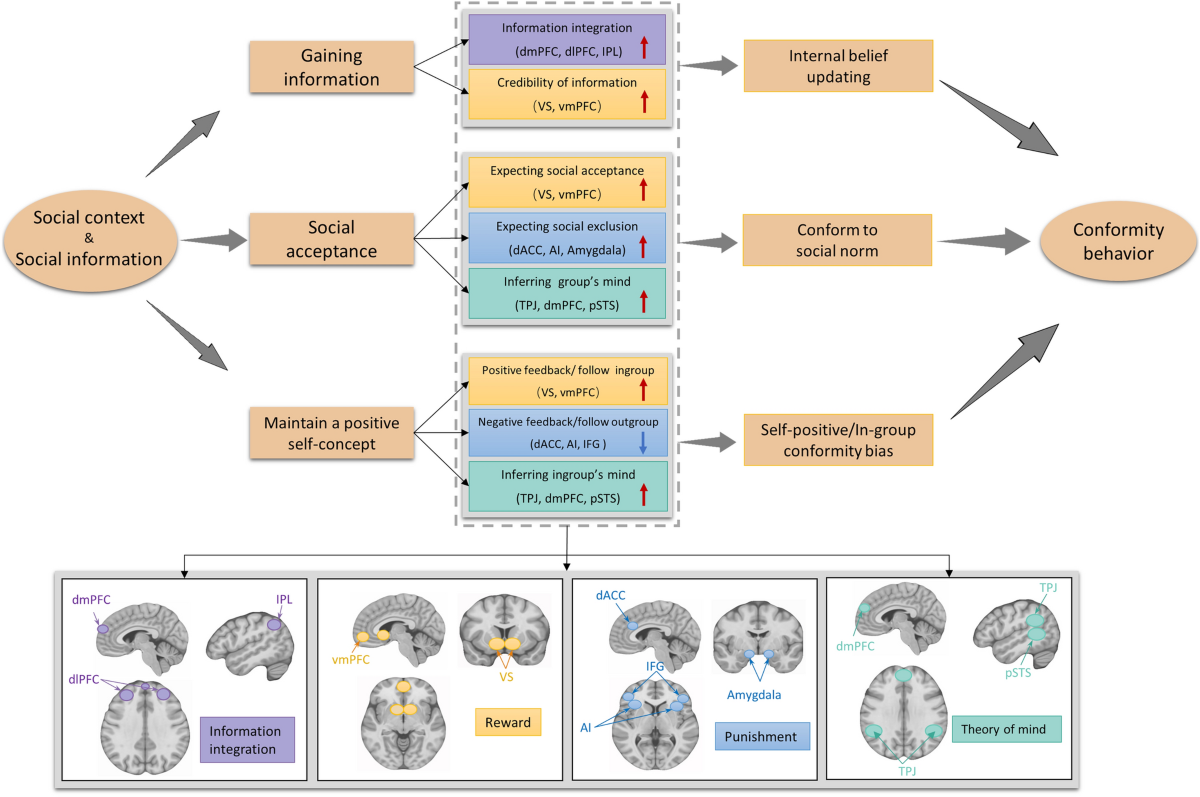
Studies using fMRI show that when people conform, brain regions involved in:
- Error detection
- Reward processing are activated (Berns et al., 2005).
When individuals disagree with a group, their brains often treat the disagreement as an error, producing discomfort. Conforming reduces this discomfort, reinforcing the behavior.
Conformity in Real Life
Some ways it happens include:
1. Workplace Conformity
In organizations, it can:
- Suppress creativity
- Encourage unethical behavior
- Promote groupthink
Employees may stay silent about problems to avoid being labeled “difficult” or “not a team player.”
2. Social Media and Digital Conformity
Likes, shares, and trending topics amplify it:
- Popular opinions feel more “correct”
- Minority views feel risky to express
Algorithms reinforce majority opinions, creating echo chambers (Sunstein, 2017).
3. Moral Conformity
People may conform even when it conflicts with their moral values:
- Ignoring discrimination
- Staying silent about wrongdoing
- Following harmful norms
This raises ethical questions about responsibility and courage.
When it Becomes Dangerous
Groupthink occurs when the desire for harmony overrides critical thinking. Symptoms include:
- Illusion of unanimity
- Suppression of dissent
- Overconfidence in group decisions
Groupthink has been linked to major failures, including political and corporate disasters (Janis, 1972).
Resisting It
Yes—but it takes awareness and effort.
Strategies to Reduce it:
- Seek dissenting opinions
- Pause before agreeing
- Ask yourself: Would I think this if I were alone?
- Build confidence in independent thinking
- Support others who speak up
Education and self-awareness reduce blind conformity, though they don’t eliminate it entirely.
Conclusion
People conform not because they are weak or irrational, but because they are human. Our brains are wired for connection, belonging, and safety. However, understanding the psychology of it gives us power—the power to pause, reflect, and choose when to stand with the group and when to stand apart.
Knowing better is the first step. Acting on it is the challenge.
References
Asch, S. E. (1955). Opinions and social pressure. Scientific American, 193(5), 31–35.
Berns, G. S., Chappelow, J., Zink, C. F., Pagnoni, G., Martin-Skurski, M. E., & Richards, J. (2005). Neurobiological correlates of social conformity. Journal of Neuroscience, 25(19), 4633–4638.
Cialdini, R. B., & Goldstein, N. J. (2004). Social influence: Compliance and conformity. Annual Review of Psychology, 55, 591–621.
Eisenberger, N. I., Lieberman, M. D., & Williams, K. D. (2003). Does rejection hurt? Science, 302(5643), 290–292.
Janis, I. L. (1972). Victims of groupthink. Houghton Mifflin.
Sunstein, C. R. (2017). #Republic: Divided democracy in the age of social media. Princeton University Press.
Subscribe to PsychUniverse
Get the latest updates and insights.
Join 3,088 other subscribers!
Niwlikar, B. A. (2025, December 22). What is Conformity and 2 Important Reasons Why They Do It. PsychUniverse. https://psychuniverse.com/conformity-reasons-why-they-do-it/