Mental Wellness

uncertainity

Uncertainity Explained: 4 Powerful Ways to Manage It

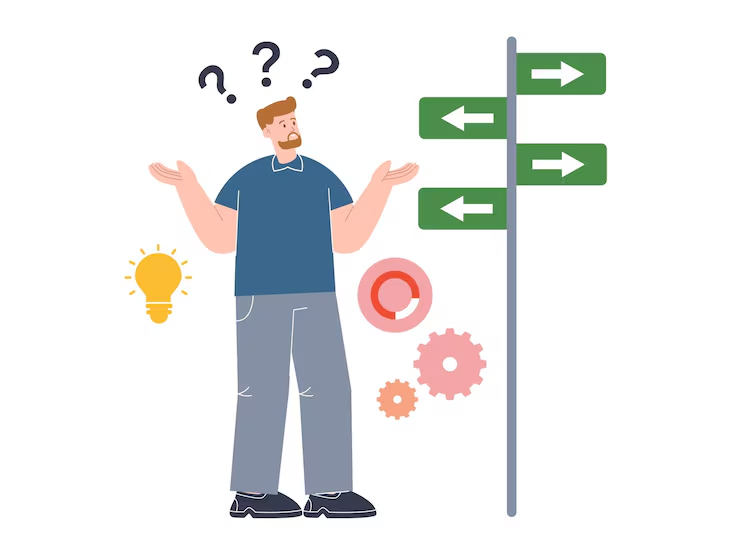
Introduction Uncertainity is an unavoidable part of human life. Whether we are navigating career decisions, financial investments, health outcomes, or social relationships, the brain is constantly interpreting incomplete information. Although we often believe risk evaluation is purely rational, neuroscience shows that uncertainity activates deep emotional, cognitive, and physiological systems designed for survival. Understanding how the […]

Uncertainity Explained: 4 Powerful Ways to Manage It Read More »

social media

How Social Media Alters Our Sense of Self and 3 Important Ways to Have a Healthy Digital Self

In the last decade, social media has become one of the most dominant forces shaping human interaction, identity, and belonging. What began as a tool for connection has evolved into a digital ecosystem that profoundly affects how people view themselves and relate to others. Platforms like Instagram, TikTok, and X (formerly Twitter) don’t just document

How Social Media Alters Our Sense of Self and 3 Important Ways to Have a Healthy Digital Self Read More »

depression

6 Important Ways Depression Looks Different in Men and Women

Depression is one of the most common mental health disorders worldwide, but it does not affect everyone equally—or appear in the same way across genders. While both men and women can experience profound sadness, hopelessness, and loss of motivation, the underlying expression, coping behaviors, and societal responses often differ. Understanding these gender differences is essential

6 Important Ways Depression Looks Different in Men and Women Read More »

introverts

Are Introverts More Empathetic? Explore 3 Important Strengths of Them

Introverts often get a reputation for being shy, reserved, or socially withdrawn. Yet, beyond their quiet demeanor lies a potential psychological advantage: heightened empathy. Empathy—the ability to understand and share the feelings of others—is a key component of social connection, emotional intelligence, and prosocial behavior. But are introverts genuinely more empathetic than their extroverted counterparts,

Are Introverts More Empathetic? Explore 3 Important Strengths of Them Read More »

narcissism

Narcissism vs. Self-Confidence and 2 Important Psychological Differences

Many people often confuse self-confidence with narcissism, assuming that someone who exudes confidence is inherently narcissistic. While both traits involve a strong sense of self, they differ fundamentally in their motivation, interpersonal impact, and psychological underpinnings. Understanding the distinction can help individuals cultivate healthy self-esteem while avoiding the pitfalls of narcissistic tendencies. Read More: Self

Narcissism vs. Self-Confidence and 2 Important Psychological Differences Read More »

parentification

What is Parentification and 5 Important Negative Outcomes of It

Introduction Childhood is ideally a time of play, exploration, and care. Yet for many individuals, it becomes a period of responsibility, emotional labor, and reversed roles. These children act as caretakers, confidants, or problem-solvers for their parents. Psychologists call this process parentification—a term that describes when a child assumes adult-like duties within the family system.

What is Parentification and 5 Important Negative Outcomes of It Read More »

ambivert

Who are Ambiverts and Learn 4 Important Traits of Them

Introduction In a world that loves categories and labels, few dichotomies are as popular as that of introverts and extraverts. Social media, self-help books, and personality tests often force people to pick a side: are you the quiet thinker or the social butterfly? However, most individuals do not neatly fit either category. Many people display

Who are Ambiverts and Learn 4 Important Traits of Them Read More »

shadow

What is Jungian Shadow and 4 Important Ways That It Matters

Introduction We all wear social masks. We present ourselves as capable, composed, and likable. Yet beneath the surface lies a hidden realm of traits, impulses, and fears that we suppress or deny. Psychologist Carl Jung called this unseen side of the personality the shadow. Engaging with it—a process known as shadow work—can lead to greater

What is Jungian Shadow and 4 Important Ways That It Matters Read More »

heuristics

How Heuristics Shape Everyday Reality and 4 Important Ways to Outsmart Them

Imagine your brain as that friend who’s always in a hurry — brilliant, intuitive, and often wrong but confident. You ask for directions, and before you finish your sentence, they’re already halfway down the street shouting, “This way!”That’s basically how heuristics work. Heuristics are the brain’s mental shortcuts — little algorithms that help us make

How Heuristics Shape Everyday Reality and 4 Important Ways to Outsmart Them Read More »

Adolescent brain

The Adolescent Brain and 5 Important Ways to Nurture It

Adolescence is often described as a time of chaos, curiosity, and transformation. It’s the stage where emotions run high, impulses take over, and every experience feels amplified. Parents might call it a “phase,” but neuroscience calls it something far more fascinating — a period of profound brain remodeling. Between roughly ages 12 and 25, the

The Adolescent Brain and 5 Important Ways to Nurture It Read More »

Scroll to Top