Mental Wellness

overthinking

Overthinking and 7 Ways to Break Its Cycle

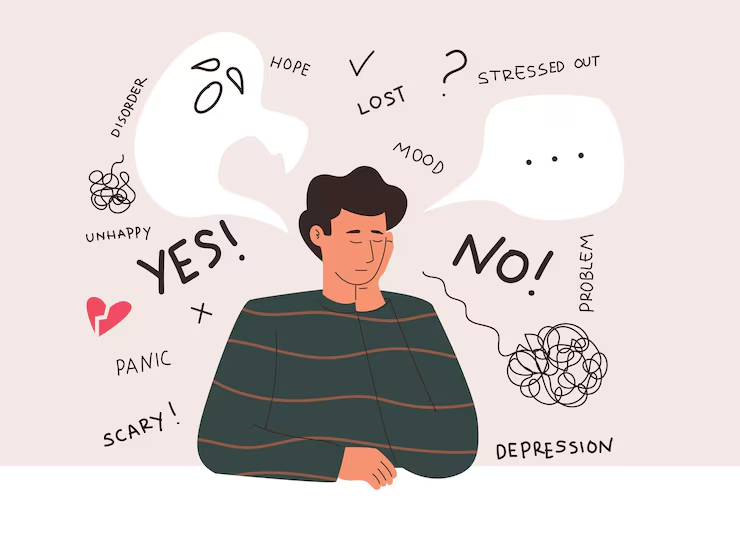
Introduction Overthinking is something nearly everyone experiences at some point: spiraling thoughts, obsessive replaying of conversations, or predicting worst-case scenarios long before they unfold. While thinking is a uniquely human strength — enabling planning, creativity, reflection, and innovation — it can turn against us when the analytical mind becomes a looping trap. Overthinking is not […]

Overthinking and 7 Ways to Break Its Cycle Read More »

perception gap

The Perception Gap and 4 Important Reasons Why It Matters

Introduction We’ve all been there: you walk out of a meeting or a social gathering convinced you made a great impression—only to later discover that others thought differently. Or you think you expressed empathy clearly, but the recipient feels unheard. Such mismatches between how we think we are coming across and how others actually perceive

The Perception Gap and 4 Important Reasons Why It Matters Read More »

inner narrator

The Psychology of Inner Narrator Voices and 4 Important Variations in It

Introduction Most people experience an internal monologue—a steady stream of thoughts, evaluations, commentary, and self-directed language. This “inner narrator” acts as a psychological companion, guiding decisions, interpreting experiences, and shaping personal identity. Yet inner speech varies enormously from person to person. Some individuals have constant, vivid inner dialogues; others experience thoughts more as images, abstract

The Psychology of Inner Narrator Voices and 4 Important Variations in It Read More »

Digital Afterlives

The Psychology of Digital Afterlives and 3 Important Therapeutic Use of It

Introduction Throughout human history, individuals have sought ways to maintain bonds with the deceased—through ritual, memory, storytelling, and symbolic objects. In the modern era, however, technology has opened an unprecedented pathway: the creation of digital afterlives through AI avatars, chatbots, holograms, and algorithmically synthesized speech and personality profiles. People are increasingly engaging with AI re-creations

The Psychology of Digital Afterlives and 3 Important Therapeutic Use of It Read More »

Self-Optimization

Self Optimisation: 4 Powerful Mechanisms Driving It

Self optimisation has become a defining feature of contemporary culture. In a society obsessed with productivity, performance, and progress, improving oneself is no longer optional—it is expected. We track sleep, monitor habits, set measurable goals, and consume endless advice on how to be our best selves. At its best, self optimisation fosters mastery, growth, and

Self Optimisation: 4 Powerful Mechanisms Driving It Read More »

pain

Why We Remember Pain Differently Than Pleasure and 4 Important Ways to Establish Balance

Introduction Think back to a time you stubbed your toe, went through heartbreak, or received devastating news. Now recall a moment of pure joy — a delicious meal, a celebration, a beautiful sunset.Which memory feels more vivid?Chances are, the pain stands out more sharply. This imbalance is no accident of memory; it’s a feature of

Why We Remember Pain Differently Than Pleasure and 4 Important Ways to Establish Balance Read More »

emotional wellness

Emotional Wellness in a Restless World and 6 Important Ways to Build It

In a world that never stops moving, emotional wellness has become both a rare commodity and a quiet revolution. We measure success by productivity, popularity, and possessions — but rarely by peace. Yet emotional wellness, the ability to understand, manage, and express feelings effectively, may be the single most important predictor of long-term happiness and

Emotional Wellness in a Restless World and 6 Important Ways to Build It Read More »

empathy

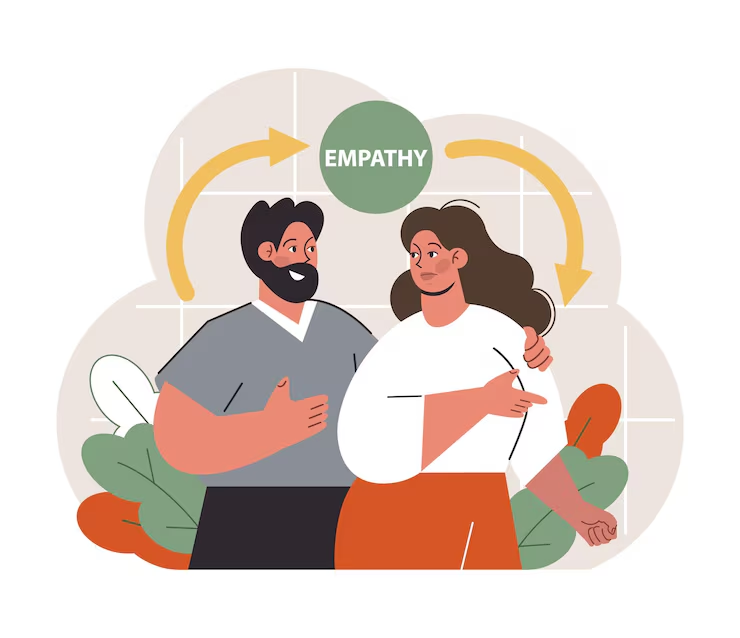
The Empathy Paradox and 4 Important Ways to Use it as a Renewable Resource

Empathy is often hailed as the glue of human connection — the ability to feel and understand what others are going through. We tell our children to be empathetic, train healthcare workers to practice empathy, and praise political leaders who appear to “feel our pain.” Yet, paradoxically, too much empathy can sometimes make us less

The Empathy Paradox and 4 Important Ways to Use it as a Renewable Resource Read More »

notification

The Cognitive Cost of Notifications and 5 Important Strategies to Reclaim Attention

Introduction You’re working on an important project, lost in thought — and then ding! A message pops up. You glance at it, decide it’s nothing urgent, and return to work. But something’s changed. You’ve lost your rhythm, your flow, and your train of thought. This everyday experience illustrates a powerful, invisible phenomenon shaping the modern

The Cognitive Cost of Notifications and 5 Important Strategies to Reclaim Attention Read More »

creativity

The Psychology of Creativity and 3 Important Networks of Creativity

Introduction We often think of creativity as lightning—sudden, unpredictable, and uncontrollable. The myth of the “creative genius” suggests that only a few gifted minds are capable of producing great ideas, while the rest of us merely admire them. Yet modern psychology paints a different picture. Creativity isn’t a mysterious gift—it’s a process rooted in the

The Psychology of Creativity and 3 Important Networks of Creativity Read More »

Scroll to Top