
Author name: Dr. Balaji Niwlikar

memory

Mind-Walks Through Time and 4 Important Practical Tips To Deal With It

Introduction What sets us apart from the rest of the animal kingdom? One contender is our capacity to escape “now.” Psychologists Thomas Suddendorf and Michael Corballis (2007) coined the term mental time travel to describe our human ability to reconstruct personal experiences from the past (episodic memory) and imagine future possibilities (episodic foresight). This capacity […]

Mind-Walks Through Time and 4 Important Practical Tips To Deal With It Read More »

Nice Guy Syndrome

Nice Guy Syndrome and 5 Important Ways to Break Free From It

Introduction “Nice Guy Syndrome” is an informal term popularized by Dr. Robert Glover to describe men who believe that being excessively nice automatically earns them love or attention. Often, these individuals suppress their needs and assertiveness in exchange for approval—creating a cycle of unspoken expectations and resentment. When expectations go unmet, anger or bitterness often

Nice Guy Syndrome and 5 Important Ways to Break Free From It Read More »

birth order

The Myth of Birth Order and 3 Important Scientific Evidences Against It

Introduction The notion that birth order determines personality is a long-standing and culturally popular belief. From the responsible and overachieving firstborns to the laid-back and rebellious youngest siblings, popular psychology has attributed a range of personality traits to one’s position in the family lineup. But do these beliefs hold any water when subjected to scientific

The Myth of Birth Order and 3 Important Scientific Evidences Against It Read More »

Inner Critic

The Inner Critic as a Developmental Fact and 5 Practical Ways to Deal With It

Introduction Almost everyone has an inner voice that critiques their actions. It whispers doubts, replays mistakes, and amplifies imperfections. This voice is the “inner critic,” and for many, it can be both a motivator and a source of emotional pain. While often treated as a psychological flaw, the inner critic may be better understood as

The Inner Critic as a Developmental Fact and 5 Practical Ways to Deal With It Read More »

soft control

Why is Soft Control Rising and 5 Ways We Can Break Its Cycle

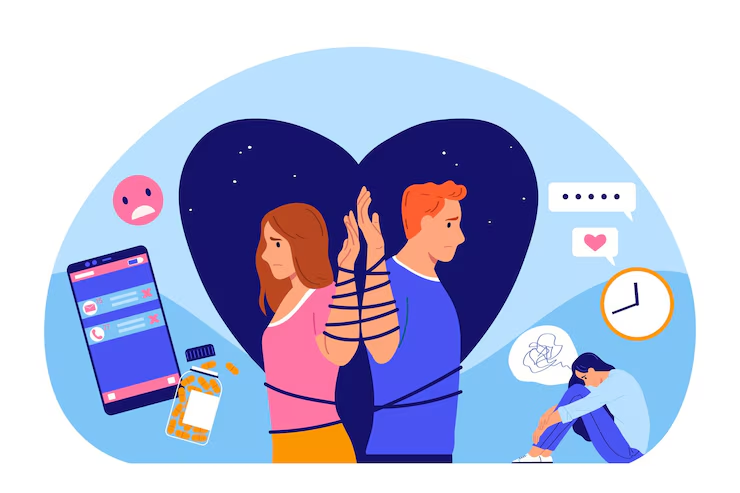
What Is Soft Control? Soft control refers to non-aggressive, subtle behaviors used to manipulate or limit another person’s freedom without resorting to direct coercion. Unlike traditional control tactics (like shouting, threats, or ultimatums), soft control relies on: Guilt Passive-aggressiveness Emotional over-dependence Love-bombing followed by withdrawal “Helpful” suggestions that actually reduce autonomy Constant emotional monitoring Dr.

Why is Soft Control Rising and 5 Ways We Can Break Its Cycle Read More »

emotional fatigue

Rise of Emotional Fatigue in Genz and 6 Important Strategies to Deal With It

What Is Emotional Fatigue? Emotional fatigue is a state of mental exhaustion caused by prolonged exposure to emotionally demanding situations. In clinical settings, it’s often discussed in the context of healthcare workers or caregivers, but a broader, more culturally pervasive form is now affecting young people on a mass scale. According to the American Psychological

Rise of Emotional Fatigue in Genz and 6 Important Strategies to Deal With It Read More »

PSYCHOLOGICAL NOMADISM

Psychological Nomadism and 4 Important Emotional Consequences to It

Introduction We all know that friend. The one who’s always “between countries,” posts from Bali on Monday and Lisbon by Friday, and claims their WiFi router is their real soulmate. But what happens to your identity, your sense of belonging, and your mental health when you live like a human Airbnb guest? Welcome to the

Psychological Nomadism and 4 Important Emotional Consequences to It Read More »

LONELINESS

Loneliness in a Hyperconnected World

Introduction We live in the most technologically connected era in human history. Messages travel instantly across continents, social media platforms offer endless streams of interaction, and digital communities promise belonging at the click of a button. Yet paradoxically, many people report feeling more lonely than ever before. This contradiction highlights a crucial truth: the quantity

Loneliness in a Hyperconnected World Read More »

Anxiety

Why Anxiety Makes Time Skitter, While Fear Freezes It and 2 Important Ways Science Proves It

Introduction Ever noticed how time appears to “fly” when there is anxiety—like cramming for an exam—and “freeze” in moments of real fear—like narrowly avoiding a car accident? These aren’t just feelings; they’re reliable shifts in how our brain measures time. Read More- Trauma and Time Anxiety vs. Fear Fear is a sharp, immediate reaction to

Why Anxiety Makes Time Skitter, While Fear Freezes It and 2 Important Ways Science Proves It Read More »

Scroll to Top